
The Architect’s New Blueprint: How to Sell AI Prompts for Architectural Visualization
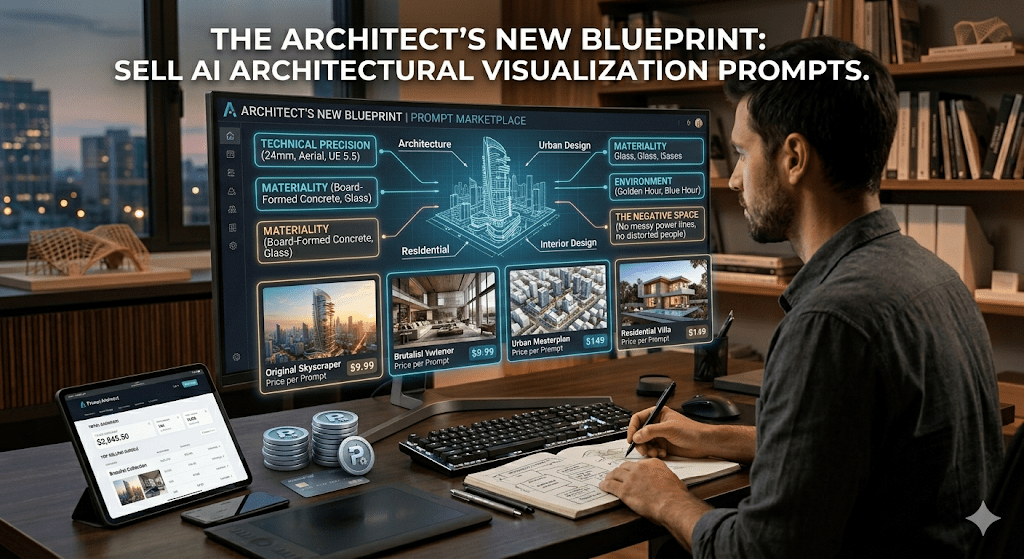
Created by gemini
The landscape of architectural visualization (ArchViz) has shifted. Gone are the days when a single high-end render took forty hours of workstation time and a decade of specialized software knowledge. While traditional rendering still has its place, the “Prompt Engineer” has emerged as a new kind of digital artisan.
In 2026, the market for AI prompts is no longer a hobbyist’s niche; it is a multi-billion dollar industry. Firms are no longer just buying stock photos; they are buying the “logic” to generate bespoke, hyper-realistic site concepts in seconds. If you have mastered the art of talking to Midjourney, Stable Diffusion, or DALL-E to create breathtaking structures, you are sitting on a goldmine of intellectual property.
This guide will walk you through the structural integrity of a successful prompt-selling business, from technical engineering to marketplace strategy.
1. The Anatomy of a High-Value Architectural Prompt
To sell a prompt, it must be more than “a modern house in the woods.” A buyer is paying for your hours of trial, error, and refinement. A professional architectural prompt is a complex formula that balances four key pillars:
A. Technical Precision (The “Hardware”)
Generic prompts produce “AI-soup”—deformed windows and impossible geometries. A sellable prompt specifies technical camera data.
- Lens Choice: Mentioning a “24mm wide-angle” for interiors or an “85mm” for facade details.
- Camera Angle: Terms like “worm’s-eye view” for monumental skyscrapers or “aerial isometric” for master planning.
- Render Engine Mimicry: Referencing industry standards like “Unreal Engine 5.5 path tracing” or “Octane Render” helps the AI understand the desired light physics.
B. Materiality and Tectonics
Architects buy prompts because they need specific textures. Your prompt should read like a specification sheet:
- Instead of “concrete,” use “poured-in-place board-formed concrete with visible tie-rod holes.”
- Instead of “glass,” use “double-glazed curtain wall with low-E coating and brushed aluminum mullions.”
C. Environmental Logic (The “Software”)
The mood sells the design. A high-value prompt includes “Golden Hour,” “blue hour,” or “volumetric fog” to create an emotional narrative.
D. The Negative Space
Crucially, professional prompts include Negative Prompts. These are the “guardrails” that prevent the AI from adding messy power lines, distorted people, or overlapping logos. When you sell a prompt, you are selling the cleanliness of the output.
2. Choosing Your Marketplace: Where to Build Your Shop
The “Prompt Economy” has matured, and several platforms now dominate the space. Each has a different audience:
| Platform | Best For | Monetization Model |
| PromptBase | Generalists and Beginners | Per-prompt sales ($2.99 – $9.99). |
| PromptHero | High-end Visual Artists | Portfolio-based leads and premium prompt access. |
| Civitai | Stable Diffusion Experts | Sharing “Checkpoints” and “LoRAs” (custom architectural styles). |
| LaPrompt | Verified Professionals | Strict quality control; higher price points for “vetted” prompts. |
| Personal Gumroad/Shopify | Established Brands | Best for selling “Prompt Bundles” (e.g., The Brutalist Collection). |
3. Productization: Bundling and Categorization
Don’t just sell one prompt; sell a Workflow. Architects don’t need a single image; they need a cohesive set of visuals for a presentation.
Create “Collections”
- The Residential Pack: 20 prompts ranging from minimalist villas to Scandinavian cabins.
- The Urbanist Pack: Prompts focused on streetscapes, mixed-use developments, and public plazas.
- The Interior Moodboard: Focused entirely on lighting, furniture textures (bouclé, walnut, marble), and spatial flow.
Use the “Seed” Advantage
In your product description, explain how buyers can use the Seed Number to maintain consistency. If they like the house in your prompt, show them how to use your formula to generate ten variations of that same house without losing the aesthetic.
4. Legalities and Intellectual Property
This is the “fine print” that protects your business. In 2026, the legal framework around AI is clearer but still requires caution.
- Trade Secret vs. Copyright: While the output of an AI may not always be copyrightable, your prompt (the text) is considered your “literary work” or a “trade secret.”
- Commercial Rights: Ensure the platform you use grants the buyer a license to use the results of your prompt for commercial architectural projects.
- Avoid “Artist Theft”: Do not sell prompts that rely heavily on the name of a living architect (e.g., “In the style of Bjarke Ingels”). Instead, describe the principles of that style (e.g., “biophilic massing, mountainous geometry, glass-wrapped terraces”). This makes your prompts more ethical and legally robust.
5. Marketing Your Prompt Store
You are an architect of words. To sell them, you need to prove they work.
The “A/B” Visual Proof
Show, don’t just tell. Your listing should include a gallery of 5–10 images generated by the exact same prompt. This proves the prompt is stable and reliable, not just a “one-hit wonder” that worked once by accident.
Leverage Social Media (The “Lure”)
- Instagram/TikTok: Post “Prompt-to-Process” videos. Show a blank screen, type a snippet of your prompt, and reveal the stunning 4K render.
- LinkedIn: Target architectural firms directly. Write posts about “Reducing Concept Phase Time by 80% with Professional AI Workflows.”
6. Pricing Strategy: The Race to the Top, Not the Bottom
Many beginners price their prompts at $1.99. This is a mistake if you are targeting professionals.
- Individual Prompts: $4.99 – $9.99 for high-complexity, highly-tested formulas.
- Masterclass Bundles: $49 – $149. These should include the prompts, a PDF guide on how to tweak them, and perhaps a custom LoRA or “Style Reference” (SREF) for Midjourney.
- Bespoke Prompt Engineering: Offer a service where you develop a “Firm-Specific Style” for an architecture studio for $500+. This ensures that every AI image they generate looks like their brand.
7. The Future: Multi-Modal and Video Prompts
As we move deeper into 2026, static images are only half the story. The real money is moving toward Video Prompts (using models like Veo or Sora) and 3D Prompts.
Selling a prompt that creates a cinematic “fly-through” of a building is worth five times more than a static image prompt. Start experimenting with temporal keywords—”camera pan,” “time-lapse lighting,” and “dynamic shadows”—to stay ahead of the curve.
Conclusion: Building Your Digital Firm
Selling AI prompts for architectural visualization is no longer about “tricking” a machine into making something pretty. It is about Terminological Precision. You are providing the bridge between an architect’s vision and the machine’s vast data.
Treat your prompt library like a digital real estate portfolio. Build it with care, structure it with logic, and market it with the authority of a professional who knows that in the age of AI, the person who asks the best questions holds the keys to the city.
Read the Best Ai freelance