
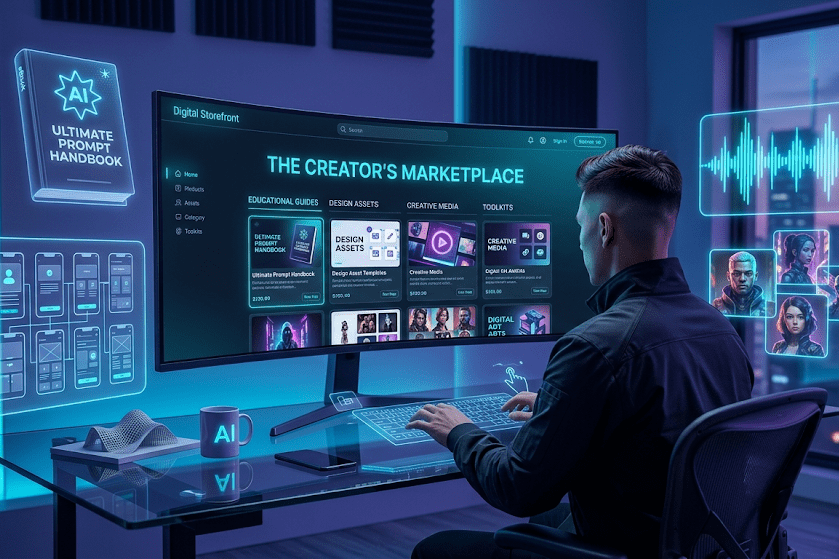
The global revenue for generative AI is projected to reach $30–$40 billion in 2026, a massive jump from previous years. In this landscape, the creator economy has shifted from manual production to “AI-assisted operation”. If you aren’t leveraging multimodal AI systems that seamlessly handle text, images, audio, and video you are working at a significant disadvantage.
This guide breaks down how to build a high-margin digital product business in 2026, from niche validation to legal protection.
1. Top Digital Products to Sell in 2026
Success in the current market requires solving specific problems for targeted audiences rather than offering generic assets.
A. AI-Enhanced Educational Products
- Prompt Libraries & Packs: These are high-demand “low difficulty” products that solve specific tasks, such as “30 LinkedIn Post Templates for Service Businesses”.
- Interactive eBooks: Unlike traditional PDFs, 2026 buyers prefer eBooks on self-help, finance, and skill development that incorporate AI-generated tools or checklists.
- Skill-Based Programs: Short, self-study courses on niche topics like “AI Prompt Engineering for Marketers” consistently sell well.
B. Business & Productivity Assets
- Notion Systems & Templates: There is strong demand for comprehensive workflows rather than simple dashboards. Think personal finance trackers that update automatically or content calendars with built-in AI prompts.
- Micro-SaaS & Niche Tools: Tiny web apps or calculators (e.g., a loan calculator or a one-page business dashboard) can be created with AI and sold for $5–$20.
- Legal & Business Document Templates: Well-written templates for contracts or SOPs (Standard Operating Procedures) save small businesses significant stress.
C. Creative & Media Assets
- Authentic Stock Media: With AI images replacing traditional stock photos, there is a booming market for cohesive sets of AI-generated images, video loops, and music tracks.
- Design Kits: Logo packs, brand identity kits, and social media bundles (like Canva social media kits for coaches) are essential for influencers without in-house designers.
2. The 2026 AI Tech Stack
In 2026, the best “stack” is rarely one tool; it is a combination of specialized AI systems.
| Product Type | Top AI Tools (2026) | Purpose |
| Writing & SEO | ChatGPT, Jasper AI, Surfer SEO | High-quality blog drafting and search visibility. |
| Visual Design | Canva, Midjourney, Adobe Firefly | AI image generation and social media post creation. |
| Video Production | Pictory, Runway, Synthesia | Creating professional promotional videos without editing skills. |
| Automation | Zapier, Gumloop | Connecting disconnected systems to automate workflows. |
3. How to Build and Validate Your Product
Most creators fail because they skip market validation. Follow this 5-step framework used by top digital sellers in 2026:
- Find Your Niche: Use keyword research tools to find high-intent phrases like “template” or “printable” with a search volume of 500+ per month.
- Validate Demand: Search Reddit, Quora, and Discord for “I wish there was a template for X.” This is your green light.
- Differentiate, Don’t Duplicate: Study top sellers on marketplaces and improve their designs by adding niche-specific features.
- Create High Value: Focus on the exact problem you solve. For example, sell “Photography for short-form video” instead of just “Photography”.
- Pre-launch Testing: Offer a mini “lead magnet” (like a free checklist) to build an email list before launching the full product.
4. Best Platforms for Selling Digital Products
Where you sell depends on your product type and technical comfort.
- Marketplaces (Etsy, Creative Market, Amazon): Best for reaching a massive pre-existing audience for digital art, planners, and eBooks.
- Simple Storefronts (Gumroad, Stan Store, Beacons AI): Ideal for creators who want a simple setup for downloads and memberships.
- Dedicated E-commerce (Shopify, Sellfy): Best for those who want full control over their brand and a dedicated site.
- Course & Community (Whop, Teachable, Thinkific): Best for creators selling memberships or structured online courses.
5. Critical Legal & Ethical Protections
In 2026, familiarity with the legal framework governing AI is essential to protect your brand.
A. Intellectual Property (IP) Ownership
In jurisdictions like the U.S. and EU, you may not receive federal copyright protection for material that lacks “adequate human authorship”. This means your competitors could theoretically circulate similar content with little legal recourse unless you prove significant human involvement in selecting and revising the content.
B. Data Privacy & Confidentiality
Be extremely careful about what data you input into generative tools. Employees unintentionally inputting sensitive company data into open AI platforms can inadvertently expose proprietary knowledge to the outside world.
C. Regulatory Compliance
If you sell products in regulated sectors like healthcare or finance, you must ensure your AI-driven content complies with laws like HIPAA or GDPR. Proactively implement internal policies and conduct regular audits of your AI usage.
Summary
The “Create once, sell forever” model of digital products is more achievable than ever thanks to generative AI. However, the marketplace is crowded. To succeed in 2026, focus on niche validation, human-in-the-loop quality control, and strict legal compliance to build a brand that lasts.
Read How to Make 500 monthly ai no coding