
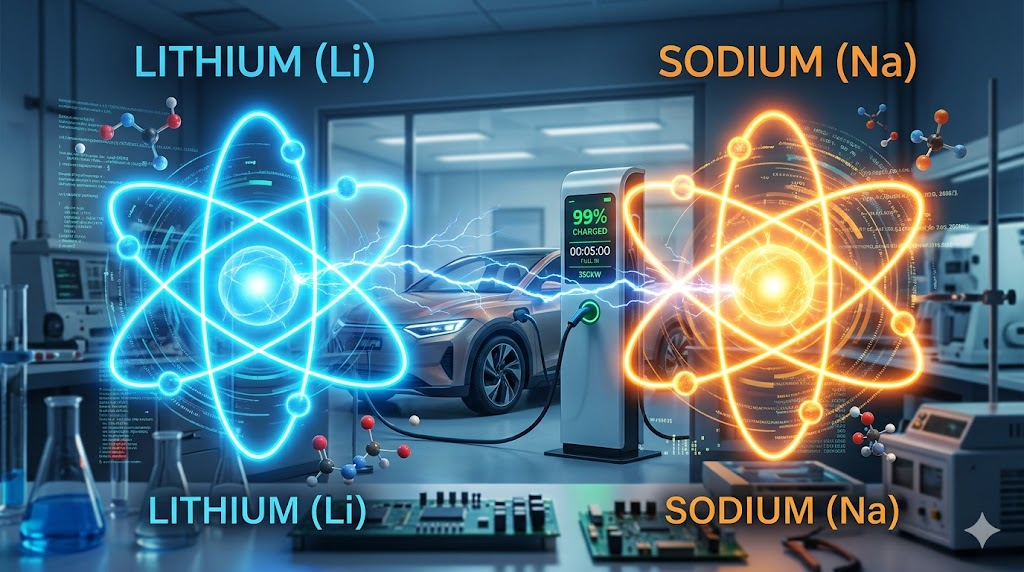
The electric vehicle (EV) revolution has long been haunted by three major “fears”: range anxiety, long charging times, and the high cost of replacement batteries. For years, Lithium-Ion technology has been the undisputed king, but it is reaching its physical limits. As we navigate through 2026, a new contender has emerged from the laboratory to the production line: Sodium-Ion.
This isn’t just a minor upgrade; it is a fundamental shift in chemistry that promises to make electric cars more affordable, safer and most importantly faster to charge than ever before. Here is why the Sodium-Ion vs. Lithium-Ion debate is the most important tech story for the next decade of transportation.
1. The Chemistry of Speed: Why Sodium is Faster
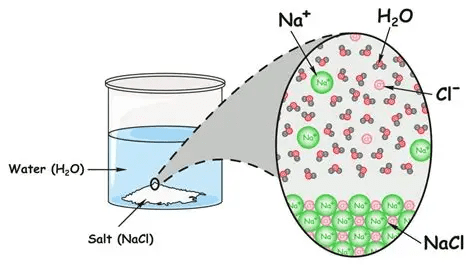
To understand why your next car might charge in the time it takes to grab a cup of coffee, we have to look at the ions. Lithium-Ion batteries rely on the movement of lithium ions between an anode and a cathode. While efficient, lithium ions are prone to “dendrite” growth when charged too quickly. These are tiny, needle-like structures that can cause short circuits and fires.
Sodium ions, however, are larger and behave differently. Recent breakthroughs in Hard Carbon Anodes have allowed sodium ions to move at incredible speeds without the risk of dendrite formation. In 2026, the first generation of ultra-fast Sodium-Ion cells is hitting the market, boasting the ability to reach an 80% charge in just 5 to 8 minutes.
For the average driver, this eliminates the “charging wall.” If you can add 300 kilometers of range in the time it takes to use a restroom at a gas station, the primary argument against EVs disappears.
2. Abundance vs. Scarcity: The Cost Revolution
Lithium is often called “White Gold.” It is expensive to mine, geographically concentrated in a few countries, and environmentally damaging to extract. As the world moves toward 100% electrification, the demand for lithium is outstripping supply, keeping EV prices high.
Sodium, on the other hand, is everywhere. It is essentially salt.
- Cost Efficiency: Sodium-Ion batteries are projected to be 30% to 40% cheaper to produce than their lithium counterparts.
- Supply Chain Sovereignty: Because sodium can be harvested from seawater or soda ash deposits found globally, every country can potentially produce its own battery cells, ending the reliance on a handful of global suppliers.
This cost reduction is the key to bringing EV prices down to the $15,000–$20,000 range, making green energy accessible to everyone, not just the wealthy.
3. Thermal Stability: Ending the Fire Risk
One of the biggest headlines surrounding EVs has been battery fires. Lithium-Ion batteries are sensitive to temperature. If they get too hot, they can enter “thermal runaway.”
Sodium-Ion batteries are inherently more stable. They can operate in extreme cold (down to -30°C) without losing significant capacity, and they are much more resistant to high-heat environments. This increased safety profile means cars don’t need complex, heavy, and expensive liquid-cooling systems, further reducing the weight and cost of the vehicle.
4. Environmental Impact: A Cleaner Path
Green energy is only “green” if the supply chain is sustainable. The extraction of cobalt and nickel—two essential components in most high-end Lithium-Ion batteries—often involves unethical mining practices and significant CO2 emissions.
Many Sodium-Ion designs are Cobalt-Free and Nickel-Free. By using abundant materials like iron and manganese for the cathode, the environmental footprint of a Sodium-Ion battery is significantly lower from “cradle to grave.” Additionally, sodium batteries are easier to recycle, as the materials don’t require the same high-energy chemical separation processes as lithium.
5. The Trade-Off: Energy Density vs. Utility
If Sodium-Ion is so great, why hasn’t it replaced Lithium yet? The answer is Energy Density. Currently, lithium batteries can store more energy in a smaller space. This means for a long-range luxury car (like a Tesla or a Lucid), lithium still wins on total distance per charge.
However, in 2026, we are seeing a “Hybrid” approach. Manufacturers are beginning to use Sodium-Ion for:
- City Cars: Where 250km of range is plenty and fast charging is more important.
- Grid Storage: For storing solar and wind energy for cities, where size doesn’t matter as much as cost and safety.
- Entry-Level EVs: Making the “first car” for young professionals affordable.
6. What This Means for You
If you are planning to buy an EV, the next 24 months will be a transition period. Lithium will remain the choice for “Performance” and “Long Range,” but Sodium-Ion will become the standard for “Daily Commuters” and “Budget-Friendly” transport.
The era of waiting 45 minutes at a charging station is ending. The era of the “Salt-Powered” car is beginning.