
How AI is Changing the Bible and the Future
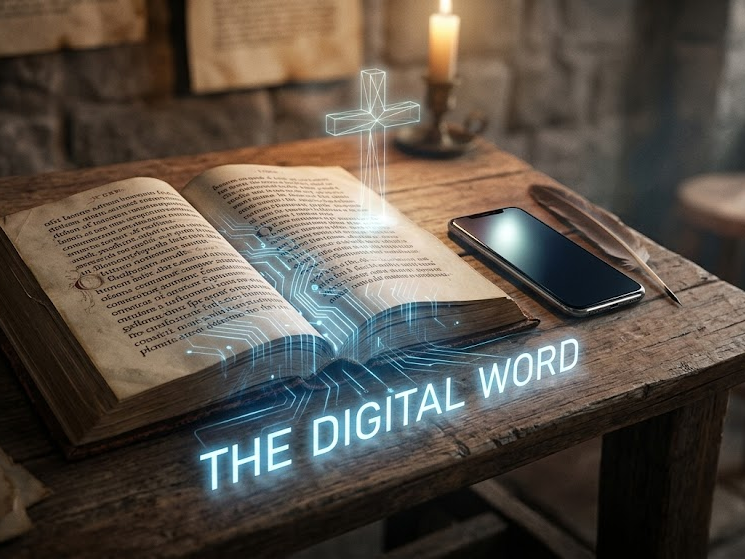
The history of the Holy Word is a history of technology. From the first stylus pressed into clay to the clattering of the Gutenberg press, humanity has always sought more efficient ways to preserve the Father’s voice. Today, we stand at a crossroads where the silicon chip meets the sacred scroll. Artificial Intelligence is not just a tool for automation. Instead, it is becoming a digital bridge. This bridge connects the ancient history of the Holy Fathers with the hyper-connected world of today.
The Legacy of the Scribes: A History of Devotion
In the early centuries, the preservation of the Bible was an act of physical and spiritual endurance. The Holy Fathers and the desert monks believed that every letter held the breath of the Creator. Scribes lived in “Scriptoriums.” These were dedicated rooms where silence was the law. They used hand-carved quills. Furthermore, they made ink from soot and gallnuts.
- The Weight of a Single Letter: If a scribe made a single error in a sacred name, the entire parchment was often buried or destroyed.
- The Time of the Word: It could take a group of monks over a year to produce a single complete copy of the Bible.
- The Reach of the Text: Because books were so rare and expensive, only the elite and the clergy could access the full depth of the scriptures.
This human-centric era was defined by reverence through labor. The difficulty of the task was seen as a form of worship. However, as the world moved into the 21st century, the challenge shifted. We no longer just preserve the text. Now, we must navigate its immense depth in a digital world.
AI: The New Scribe of the 21st Century
In 2026, Artificial Intelligence has taken over the role of the scribe. It works with a speed that would have seemed miraculous to the Holy Fathers. AI does not simply “copy” text. Instead, it reconstructs the experience of the Word through data processing.
Deep Analysis: The Digital Archeology of Faith
Modern technology allows us to look “underneath” the text. AI algorithms are currently being used to scan ancient, charred scrolls found in historical sites that were previously impossible to unroll. Through X-ray tomography and machine learning, AI can see the ink hidden inside a crust of carbon, bringing words back to life that have been silent for 2,000 years. This is a deep, technological resurrection of history.
The Shift in Translation
For centuries, translation was a slow, human struggle. Today, Neural Machine Translation (NMT) allows the Bible to be adapted into rare dialects at a pace never seen before. By 2026, AI has enabled the translation of the Bible into nearly every living language, fulfilling a historical mission of the church through silicon and code.
Classification of Engagement: Faith Across Generations
To understand how today’s technology interacts with the Bible, we must classify how different age groups utilize these digital tools. The interaction with the Father’s Word is no longer one-size-fits-all; it is personalized by AI to meet the psychological and spiritual needs of every generation.
| Generation | Interaction Style | Primary AI Tool | The Spiritual Result |
| Alpha (Children) | Visual & Interactive | AI-Generated Storytelling | Engaging with the Bible through animated, personalized parables. |
| Gen Z (Youth) | Fast & Analytical | AI Concordances & Summarizers | Seeking “the point” quickly; using AI to track themes across 66 books in seconds. |
| Millennials & Gen X | Deep Study & Integration | Theological AI Agents | Using AI to compare Greek/Hebrew roots while balancing busy professional lives. |
| Boomers & Elders | Audio & Accessibility | AI Voice Synthesis | Listening to the Word read in familiar, comforting “clerical” voices via high-fidelity AI audio. |
Recommended AI & Apps for the Modern Believer
If you are looking to integrate the best of today’s technology into your spiritual life, certain tools stand out for their accuracy, safety, and depth.
1. Perplexity AI (For Deep Research)
Why: Unlike standard chatbots, Perplexity provides real-time citations. When you ask about a specific historical event in the Bible, it pulls from academic journals, historical archives, and theological commentaries simultaneously. It is the best tool for those who want to avoid “hallucinations” and stick to verified history.
2. Logos Bible Software (With AI Integration)
Why: Logos has been the gold standard for scholars for years, but its 2026 AI updates are revolutionary. It can now generate “Smart Summaries” of complex theological debates from the 4th century and link them directly to modern-day applications.
3. YouVersion (The AI Search Feature)
Why: The world’s most popular Bible app now uses advanced AI to help users find verses based on emotions rather than just keywords. You can tell the app, “I feel overwhelmed by my career,” and the AI will curate a specific path of scriptures that address that specific feeling, mimicking the guidance of a spiritual father.
4. Claude 3.5/4 (For Theological Writing & Comparison)
Why: Claude is known for its “human-like” nuance. It is excellent at taking a complex passage and explaining it in simplified English without losing the sacred “weight” of the text. It is a brilliant tool for content creators and teachers.
The Hidden Impact: A Critical Analysis
While we celebrate these advancements, we must remain aware of the Hidden Realities of AI’s influence on the Bible.
- The Loss of Mystery: By making every answer instant, we risk losing the “patient waiting” that defined the prayer lives of the Holy Fathers. The Father’s voice is often found in the silence, not just in the data.
- The Algorithmic Filter: If you rely on an AI to choose which verses you read, you are trusting a mathematical formula to guide your soul. We must ensure that the “Randomness of the Spirit” is not replaced by the “Optimization of the Code.”
- Environmental Cost: As a tech-forward platform, we must acknowledge that a single deep theological search on a Large Language Model consumes enough energy to power a small household for minutes. Our digital worship has a physical footprint.
The Future: A Digital Priesthood?
As we look toward the end of 2026, the question is not if we should use AI, but how we use it to honor the legacy of the Holy Fathers. We are moving toward a “Digital Codex”—a version of the Bible that is interactive, multi-lingual, and deeply personal.
The scribes of old gave their lives to preserve the Word. We, the digital generation, must give our attention to ensure that this technology does not just “process” the Word, but helps us live it. By combining the best AI tools like Perplexity and Logos with a heart of reverence, we can ensure that the ancient wisdom of the Father remains as vibrant and powerful today as it was in the days of the desert monks.
The Divine Code is here. It is our responsibility to use this silicon scribe to write a new chapter of faith that is as smart, attractive, and deep as the scriptures themselves.