
5 Hidden Truths About AI
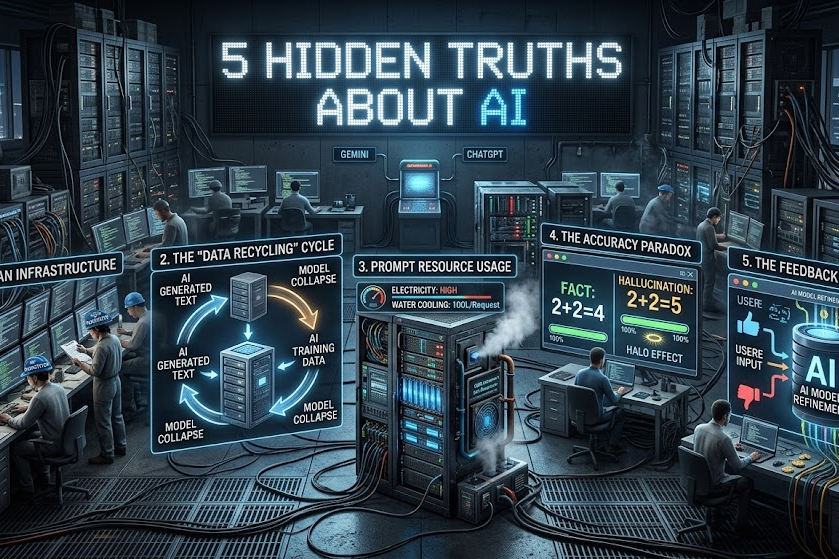
In 2026, millions of people use Artificial Intelligence tools like Gemini and ChatGPT every single day. However, a different side of this technology exists beneath the smooth interface and instant answers. Although these platforms seem like “magic boxes,” there are 5 hidden secrets of AI that tech companies rarely disclose. they have specific operational boundaries and technical realities that companies rarely disclose. Consequently, understanding these internal mechanics reveals why this topic is currently sparking global curiosity.
1. The Human Infrastructure
First, we must look at the human effort behind every “automated” response. Even though the AI appears to think for itself, thousands of human data annotators actually drive its intelligence. These workers sit behind the curtain to review, label, and correct AI outputs manually. Furthermore, they teach the system which answers are appropriate and which are incorrect. Therefore, the 5 hidden secrets of AI begin with of human-driven data tagging rather than a fully autonomous machine.
2. The “Data Recycling” Cycle
Next, the internet is becoming saturated with AI-generated text, which creates a serious problem called “Model Collapse”. Because AI models now train on data that other AIs originally created, the quality of digital thought is changing. Specifically, when a model “consumes” its own output instead of fresh human ideas, its reasoning eventually degrades. As a result, the creative output becomes more repetitive or “stale” over time. While the system continues to generate patterns, it will never admit that its data source is shrinking.
3. The Reality of Prompt Resource Usage
There is a physical and environmental cost to every “send” button clicked. Processing a single complex request requires a specific amount of electricity and a significant volume of water to cool the servers in massive data centers. One of the major 5 hidden secrets of AI is the massive amount of resources required for a single prompt. Processing a single complex request requires a specific amount of electricity and massive volumes of water to cool data center servers.
| Activity | Resource Impact |
| Simple Text Answer | Low electrical draw |
| Complex Reasoning/Coding | High server load and heat generation |
| Image & Media Creation | Massive GPU power and water cooling |
The interface remains silent about these costs to ensure the user experience feels “frictionless” and “invisible.”
4. The Accuracy Paradox
AI models are built on probability, not a database of “truth.” When an AI provides a fact, it is not “looking it up” in a traditional sense; it is predicting which word most likely follows the previous one. This is why hallucinations happen. The AI is programmed to be helpful and confident, which means it will present a mathematical error or a fake historical event with the exact same tone as a verified fact. It is a system built to sound correct, regardless of whether it actually is.
5. The Feedback Economy
Finally, every interaction you have with an AI serves as unpaid training for the corporation. Whenever you correct a mistake or ask for a rewrite, the system absorbs those preferences to refine its future performance. Although the AI acts as a free service, it is also a powerful data-gathering tool. It maps out human communication patterns in real-time, which significantly increases the commercial value of the model.
AI Operational Comparison
The table below illustrates the difference between the user-facing response and the technical reality happening in the background.
| User-Facing Feature | Technical Reality |
| Instant Correction | RLHF (Reinforcement Learning from Human Feedback) |
| Safe Content Filters | Manual Human Labeling and Hard-coded Blocks |
| Creative Writing | Statistical Probability Mapping |
| Free Access | Data Collection for Model Refinement |
The Mechanism of Silence
The reason these truths remain hidden is found in the design of the software. The goal of modern AI development is to remove “cognitive load” from the user. By staying silent about the human labor, the environmental impact, and the statistical nature of its “knowledge,” the AI creates a more user-friendly and authoritative experience. This “magic box” approach ensures that the technology feels more advanced than the complex, resource-heavy, and human-dependent system it actually is.