
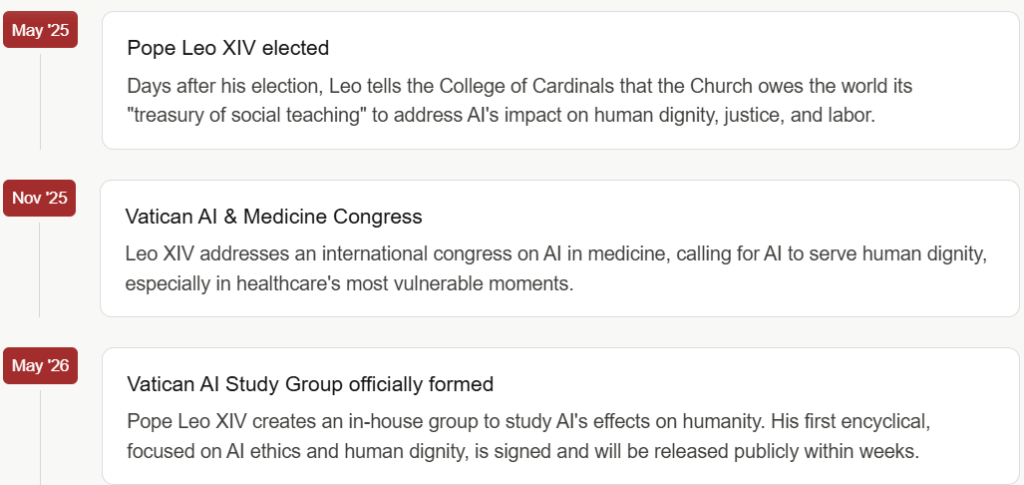
Pope Leo XIV launched an official Vatican study group on artificial intelligence and his first major letter to the world is almost ready. This is bigger than it sounds. Pope creates AI study group

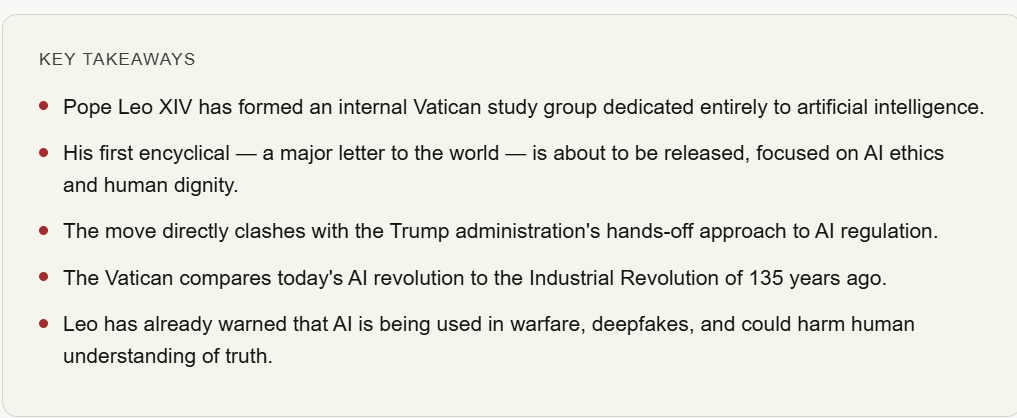
Something big just happened. Most people scrolled past it. On Saturday, May 16, 2026, the Vatican announced that Pope Leo XIV had created an official study group on artificial intelligence. Hours later, the world learned that his very first encyclical — a formal letter from the Pope to the entire world — was already signed and would soon go public.
That letter argues strongly for one idea: AI must protect human dignity, promote peace, and serve working people not just corporations or governments.
This story matters whether you follow religion or not. Tech policy, AI governance, and the future of work are all on the table
What did the Vatican actually announce?
The Vatican stated that Pope Leo XIV chose to create the study group because of the rapid acceleration in AI use and its possible effects on human beings. The official statement also cited the church’s concern for the dignity of every human being as a central reason.
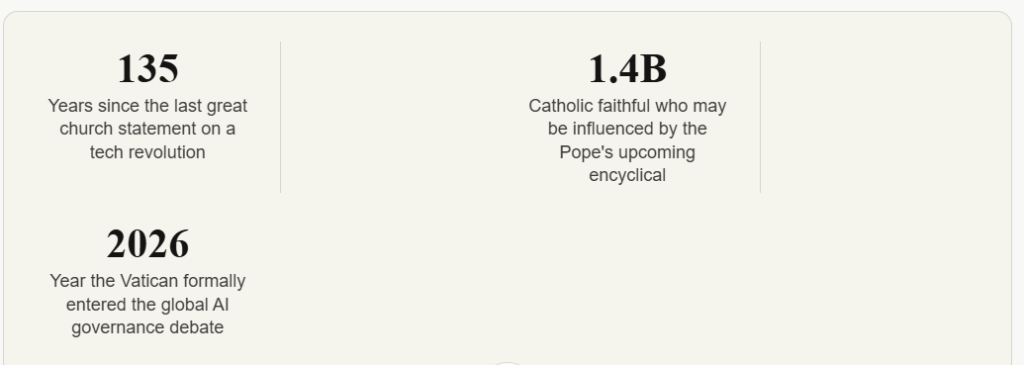
This is not just a committee. It sends a clear signal. When the Vatican formally creates a body to study something, it sets the stage for official church teaching. In the Catholic tradition, that teaching carries enormous moral weight not just for 1.4 billion Catholics, but for governments and international institutions that treat the Vatican as a serious global voice.
Who is Pope Leo XIV and why does he care about AI?
Leo XIV grew up in Chicago. He studied mathematics. His sharp, analytical mind sets him apart from most church leaders. As an Augustinian friar, Leo belongs to a religious order that puts the pursuit of truth at the very center of its spiritual life.
That background shapes his view on AI. He is particularly worried about deepfakes — fake images and videos that spread false information at scale. For someone whose entire spiritual tradition centers on truth, a tool that manufactures convincing lies on demand is not just a tech problem. It is a moral crisis.
Warfare is another area where he has spoken loudly. He calls for strict monitoring of automated weapons systems — drones, maritime platforms, and AI-guided targeting tools — in Ukraine, Gaza, Lebanon, and Iran. His words on this are direct. Leo describes what is happening in those war zones as the inhuman evolution of the relationship between war and new technologies.
At the same time, Leo XIV is not anti-technology. In a 2025 speech at an AI conference, he acknowledged that generative AI has made real contributions to healthcare and scientific discovery. A ban is not what he wants. Wisdom is.
The timing: 135 years is not a coincidence
The day before the Vatican announced the study group, Pope Leo XIV signed his encyclical. He chose the date deliberately. It falls exactly 135 years after his namesake, Pope Leo XIII, dated his most famous encyclical Rerum Novarum, which translates to Of New Things.
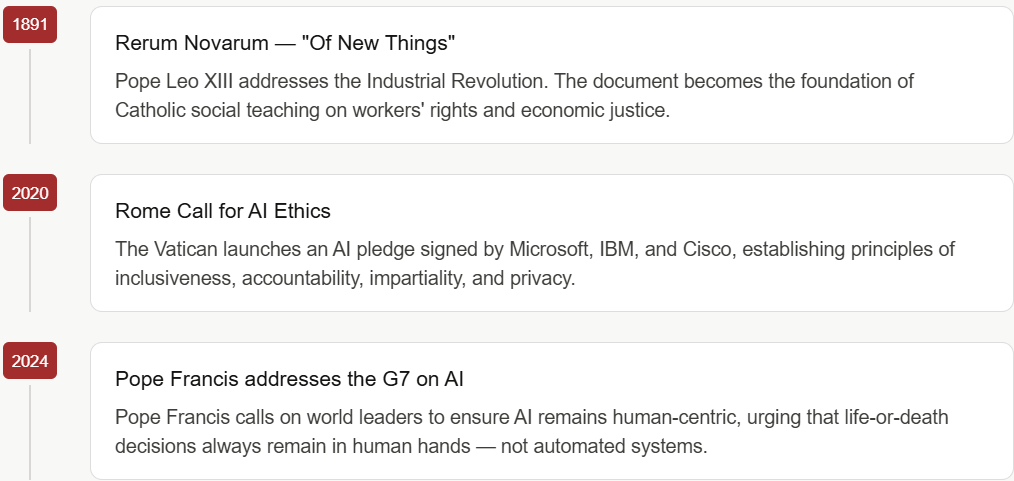
That 1891 document tackled one of the great crises of its era: the Industrial Revolution. Factories had begun replacing farm workers. Poverty spread fast. Workers had almost no rights or legal protection. Leo XIII wrote to the world about what workers deserved, what capitalism owed them, and how states must respond. That document became the foundation of modern Catholic social teaching. It influenced labor law, workers’ rights movements, and social policy across dozens of countries for more than a century.
Leo XIV sees AI as today’s version of that same crisis. The Industrial Revolution disrupted the economy and reshaped the nature of work. The AI revolution does the same — only faster, and with even deeper questions about what it means to be human.
The Vatican’s AI timeline
The political flashpoint: Vatican vs. Washington
Tension is building fast. The encyclical will likely create a public clash between Pope Leo XIV — an American pope — and the Trump administration.
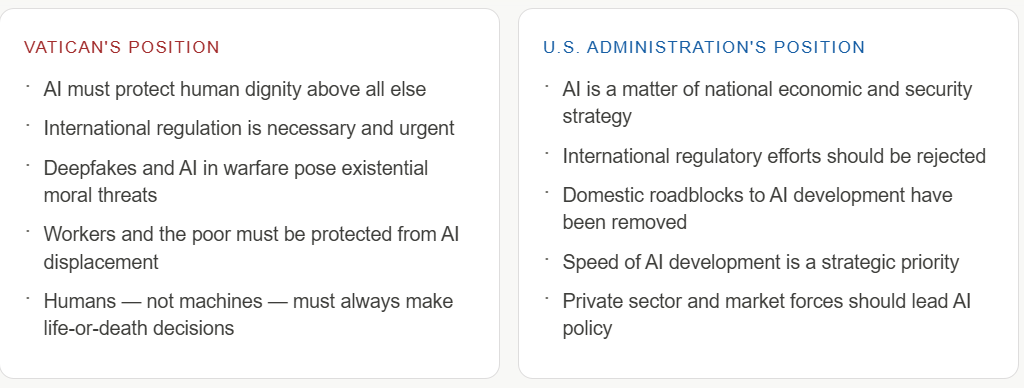
Washington treats AI development as a matter of vital national economic and security strategy. The U.S. has actively pushed back against international regulatory efforts. Domestically, the administration removed roadblocks that were slowing AI deployment. Days ago, President Trump wrapped up a visit to China with major AI business on the agenda. Traveling with him on Air Force One were Elon Musk and Nvidia CEO Jensen Huang — two of the most powerful figures in the global AI industry.
The Pope is about to tell the world the opposite: speed without ethics causes harm. Human dignity must come before profit and national strategy. Technology that deceives, manipulates, and kills requires governance rooted in something greater than market forces.
Two very different visions for AI
What is an encyclical and why does it matter?
An encyclical ranks among the highest-level documents a pope can issue. Addressed to the entire world — not only to Catholics — it lays out the church’s position on a major issue of global concern. Writing one takes years of research and consultation. Publishing one signals that the church treats an issue as critically serious.
History shows the power of this format. When Pope Leo XIII published Rerum Novarum in 1891, the ideas inside helped shape labor laws, workers’ rights movements, and social safety nets across dozens of countries. The current Leo XIV clearly hopes his encyclical on AI will do the same.
What does this mean for AI companies and tech workers?
AI companies are used to dealing with governments and regulators. Dealing with a 2,000-year-old institution is a different challenge. The Vatican commands the moral attention of 1.4 billion people and holds a seat at nearly every international table. When the Pope speaks on a major issue, politicians in Catholic-majority countries across Latin America, Africa, Southern Europe, and Asia listen closely.
The Vatican has already demonstrated real convening power on tech issues. In 2020, Microsoft, IBM, and Cisco all signed the Rome Call for AI Ethics. Now, with a math-trained pope who warns against using AI to write sermons, speaks at AI conferences, and raises moral alarms about autonomous weapons — the Vatican is no longer a bystander. It is becoming an active force shaping what AI should and should not be allowed to do.
The deepfake problem: truth as a spiritual issue
Leo XIV’s concern about deepfakes goes beyond policy. For an Augustinian friar, it cuts to the soul of his spiritual tradition. Saint Augustine, who founded the order, built his entire philosophy on the search for truth. Generative AI that creates convincing lies on demand fake images, fake voices, fake videos of real people — is not just a tool misused. In this worldview, it attacks something sacred.
He has questioned what this does to humanity’s ability to grasp reality to remain open to truth and beauty. These are not abstract concerns. They describe a world where no one can trust what they see or hear. Political manipulation, fraud, and harassment all grow larger when anyone with a phone can generate a convincing fake.
AI in warfare: the issue Leo keeps raising
Again and again, Leo XIV returns to the issue of AI in armed conflict. He calls urgently for monitoring of automated weapons systems in active war zones. This is not hypothetical. In Ukraine, AI guides drone strikes and processes battlefield intelligence. In Gaza, automated systems play a role in decisions that once required human commanders alone.
The central question is stark: should a machine ever make a lethal decision without a human authorizing it in that exact moment? Leo XIV answers clearly. What he sees happening in Ukraine, Gaza, Lebanon, and Iran illustrates what he calls a spiral of annihilation. Expect this to be a central theme of both the encyclical and the new AI study group’s work.
What should you watch for next?
Watch for the public release of the encyclical. Within weeks, the first major papal document ever focused primarily on artificial intelligence will reach the world. Newsrooms, parliaments, corporate boardrooms, and university classrooms will read and debate it.
After that, track what the AI study group produces. Study groups with direct papal backing generate real recommendations with real weight. Future Vatican statements on AI regulation, AI in healthcare, AI in warfare, and AI’s impact on work will flow from this group’s findings.
Finally, watch Washington. The coming weeks may bring a genuine, public clash between the world’s most powerful secular government and one of the world’s oldest moral institutions both fighting to define what AI means for humanity.