
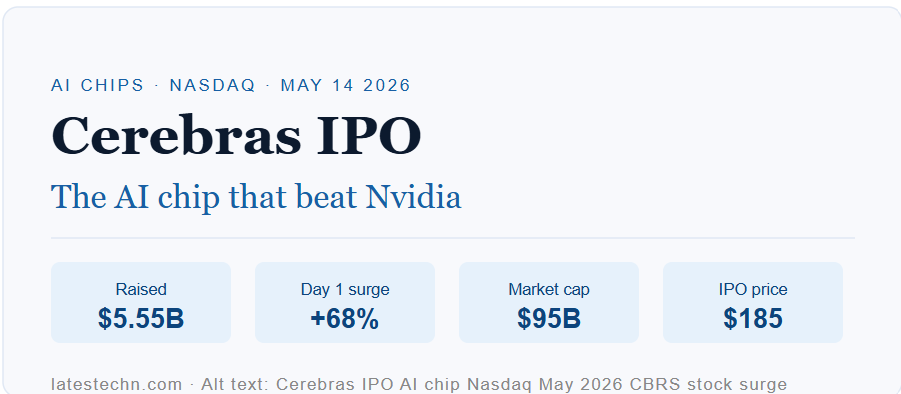
I want to tell you about a company that most people had never heard of three weeks ago — and is now worth $95 billion. That company is Cerebras Systems. And what happened when it went public on May 14, 2026 is one of the most exciting things I have seen in tech investing in years.
Cerebras is an AI chip company. But it is not just another chip company. It builds chips that are physically bigger than anything else on the market. We are talking about a chip the size of a dinner plate. And it claims those chips run AI faster and cheaper than Nvidia’s famous GPUs. That is a very big claim. Nvidia is the most powerful chip company in the world right now. So when a smaller company says it can beat Nvidia at its own game — people pay attention.
On Thursday May 14, Cerebras started trading on the Nasdaq stock exchange under the ticker symbol CBRS. The stock opened at $185 per share. By the end of the day, it had closed at $331.07. That is a 68% gain in a single day. Investors poured money in like they had been waiting for this moment for years. In many ways, they had.
“The stock went from $185 to $331 in one day. That is not normal. That is the market screaming that it believes in what Cerebras has built.”
What is Cerebras and what does it actually make?
Let me explain Cerebras in simple terms. When you use an AI tool like ChatGPT, Google Gemini, or any other AI assistant, there is a computer somewhere running calculations to give you that answer. Those calculations need very powerful chips. Right now, most of those chips come from Nvidia. Nvidia’s GPU chips dominate this market with about 80% market share. Everyone uses Nvidia. Even OpenAI uses Nvidia.
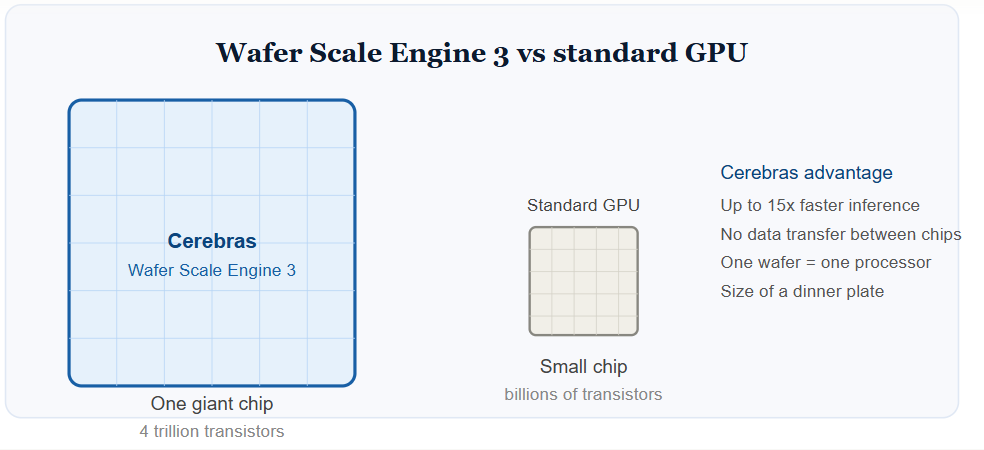
Cerebras decided to build something different. Instead of making many small chips and connecting them together, Cerebras builds one giant chip that covers an entire silicon wafer. They call it the Wafer Scale Engine 3. It packs over 4 trillion transistors onto a single piece of silicon. For comparison, a typical high-end chip has a few billion transistors. Cerebras has 4 trillion on one piece.
Why does that matter? Because when you run AI on many small chips connected together, there is a lot of time wasted moving data between chips. Cerebras eliminates that problem. Everything runs on one huge chip. The result is that Cerebras claims its chips run AI models up to 15 times faster than Nvidia’s GPUs for certain tasks. That is the pitch. And companies like OpenAI and Amazon have believed it enough to sign major deals.
Cerebras focuses on AI inference the process of running an AI model to give you answers rather than training. Training is what teaches the AI. Inference is what you experience when you ask the AI a question.
The IPO numbers what actually happened
Let me walk you through the full story of how this IPO came together, because it is interesting in itself.
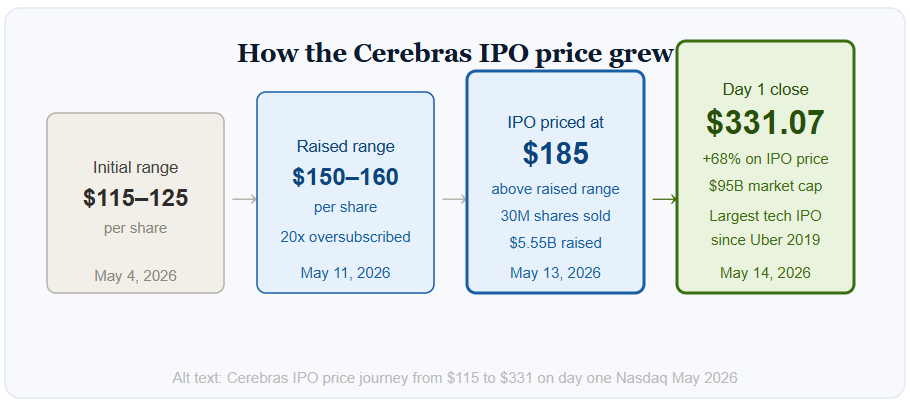
Cerebras first filed its IPO paperwork with the US Securities and Exchange Commission in April 2026. At that time, it said it was worth around $33 billion. Then it started the roadshow a process where the company’s leaders travel around and pitch to big investors. The response was overwhelming. The order book was 20 times oversubscribed. That means for every share available, there were 20 investors wanting to buy it.
Because of that demand, Cerebras kept raising its price. It started at $115 to $125 per share. Then it raised that to $150 to $160. Then it priced the final IPO at $185 — above even that raised range. It sold 30 million shares and raised $5.55 billion. That is the largest tech IPO since Uber went public in 2019. That was seven years ago. This is a very big deal.
On the first day of trading, the stock nearly doubled. It closed at $331.07. The CEO of Cerebras, Andrew Feldman, ended the day with a personal stake worth around $3.2 billion. The CTO, Sean Lie, held a stake worth $1.7 billion. Two people became billionaires in a single afternoon. That is the power of what happened here.
“Cerebras raised $5.55 billion — the largest US tech IPO since Uber in 2019. That tells you everything about how hungry investors are for AI chip exposure right now.”
The OpenAI deal that changed everything
One of the reasons investors got so excited about Cerebras is a deal it signed with OpenAI in January 2026. OpenAI — the company behind ChatGPT — agreed to use Cerebras computing capacity worth more than $20 billion. This is a deal that runs until 2028. That is two years of guaranteed revenue from one of the most important AI companies in the world.
When Cerebras was raising money for its IPO, this deal was the centrepiece of the pitch. If OpenAI trusts Cerebras enough to sign a $20 billion deal, that tells every investor in the world that the technology works. You do not sign a $20 billion deal with a company whose chips do not perform.
Amazon also got involved. In March 2026, Amazon Web Services announced it would offer Cerebras chips in its data centres. This means any developer building on AWS can now access Cerebras chips to run their AI models. Amazon and OpenAI both hold warrants to buy Cerebras stock meaning they have a direct financial interest in seeing the company succeed. That is a very unusual situation for a newly public company. It means two of the biggest companies in tech are essentially betting on Cerebras from the inside.
Before the IPO Arm and SoftBank tried to buy it
Here is something that did not get much attention in the mainstream coverage. Weeks before Cerebras went public, two major companies tried to acquire it. Bloomberg reported that both Arm the chip design company and SoftBank the Japanese technology investment giant attempted to buy Cerebras before the IPO. Cerebras said no to both of them.
Think about what that means. If you are a company about to go public, and two of the world’s most powerful tech companies offer to buy you, and you say no you are telling the world that you believe your company is worth more than they were offering. Cerebras chose to go public instead. And the market reaction on day one suggests that decision was correct.
This detail matters because it shows that Cerebras was not desperate for an exit. It had options. It chose the path that would give it the most independence and the biggest valuation. That is confidence. And confidence in a company’s future is exactly what investors want to see.
The real financial numbers not just hype
When you look at an IPO, it is easy to get distracted by the excitement and ignore whether the company actually makes money. So let me give you the real numbers from Cerebras.
In 2025, Cerebras generated $510 million in revenue. That was up 76% from the year before. Growing 76% in one year is extremely fast for a hardware company. Even more importantly, the company swung from a loss of $481 million in 2024 to a profit of $88 million in 2025. It turned profitable. That is not common for a tech company at this stage of growth.
The non-GAAP net income which strips out some one-time costs was $237.8 million. That means the core business is genuinely making money, not just burning cash to grow. Compare that to many tech IPOs where the company loses money every single quarter. Cerebras is different. It is growing fast and it is profitable. That combination is what made investors so excited.
Cerebras was founded in 2016 by Andrew Feldman and Sean Lie. It is based in Silicon Valley and has fewer than 800 employees. A company of that size generating $510 million in revenue is remarkably efficient.
The risks — not everything is perfect
I want to be honest with you here. Cerebras has real risks. Any good analysis has to talk about them.
The biggest risk is customer concentration. In the first half of 2024, one customer believed to be closely tied to OpenAI represented about 87% of Cerebras revenue. That means if that one relationship goes wrong, the company loses almost all its money. The OpenAI deal and the Amazon partnership have improved this situation significantly. But concentrated customers are always a risk in a hardware business.
The second risk is Nvidia itself. Nvidia is not going to sit still while Cerebras eats into its market. Nvidia has enormous resources, a massive software ecosystem called CUDA that millions of developers use, and the trust of every major AI company. Nvidia also acquired Groq a company with chips similar to Cerebras in December 2025 for $20 billion. That means Nvidia is directly building a product to compete with Cerebras.
The third risk is that analysts from Davidson an investment banking group described Cerebras chips as “niche-y.” They said the technology is impressive but still in early stages of maturity, and less flexible than existing GPU systems. Not every AI workload benefits from Cerebras chips. For many tasks, Nvidia’s system is still better simply because of its software compatibility and flexibility.
After the 68% first-day surge, Cerebras stock fell 10% on Friday May 15. This is completely normal after a big IPO — early investors take some profits. The long-term story is still very much intact.
What this means for the wider AI chip market
The Cerebras IPO is not just a story about one company. It is a signal about where the entire technology industry is going in 2026.
AI needs chips. A lot of chips. More chips than any company in history has ever needed. Right now, the biggest tech companies in the world Meta, Amazon, Microsoft, and Google — have collectively committed $725 billion in spending for 2026, almost all of it on AI infrastructure. That means data centres, power systems, and chips. Enormous quantities of chips.
Nvidia supplies most of those chips right now. But no industry stays with one supplier forever. The more dependent the world becomes on AI, the more important it becomes to have alternatives to Nvidia. Cerebras is positioning itself as that alternative at least for certain types of AI work. And the fact that OpenAI and Amazon have already signed on suggests the alternative is working.
Looking beyond Cerebras, this IPO is expected to open the door for even bigger tech listings later in 2026. SpaceX, OpenAI, and Anthropic are all expected to go public later this year. Cerebras was described by analysts as a “warm-up act” for those much larger listings. If a $95 billion AI chip company can generate this kind of excitement, imagine what the response will be when OpenAI the creator of ChatGPT finally goes public.
My personal take on this
I have been watching the AI chip market for a while now. What strikes me about Cerebras is not just the technology — it is the timing. The company built something genuinely different, found customers who were big enough to validate it, stayed private long enough to achieve real profitability, and then went public at exactly the moment when investor appetite for AI chips was at its peak.
That is not luck. That is strategic. Andrew Feldman has been running Cerebras for ten years. He turned down an acquisition from Arm and SoftBank. He walked away from a merger that OpenAI once proposed in 2017. He waited. And when he finally went public, the company was profitable, growing fast, and had two of the biggest names in tech as partners.
Whether Cerebras can maintain this momentum against Nvidia is a completely different question. Nvidia is still dominant. The CUDA software ecosystem that Nvidia has built over 15 years is genuinely hard to compete with. Developers know CUDA. They trust it. Switching to a new chip architecture means rewriting code, retraining teams, and taking on risk. That is a real barrier for Cerebras to overcome.
But for specific workloads particularly AI inference at scale Cerebras makes a compelling case. And OpenAI and Amazon are not companies that sign $20 billion deals out of charity. They sign them because the technology performs. That is the most convincing signal of all.
FAQ
Read