
Introduction: Why Your Phone Keeps Getting Faster 5G Network
Think about this: 30 years ago, a phone could only make calls. Today, you can stream a 4K movie, video call your family across the world, and control a smart home all from your pocket.
How did we get here?
- The answer is mobile network generations — 1G, 2G, 3G, 4G, and now 5G.
In this guide, we break it all down in simple English. No engineering degree needed. Whether you are a student, a business owner, or just a curious person — by the end of this post, you will understand what each generation does, why 5G is such a big deal, and what the future holds.
Let us start from the beginning.
What Is a “G” in Mobile Networks?
The “G” stands for Generation. Each new generation means a new set of rules (called standards) for how phones send and receive data. Read
Every generation brings:
- Faster speeds — download and upload data quicker
- Lower latency — less delay between sending and receiving
- More capacity — more people can connect at the same time
- New possibilities — things you could not do before become possible
Now let us walk through each one.
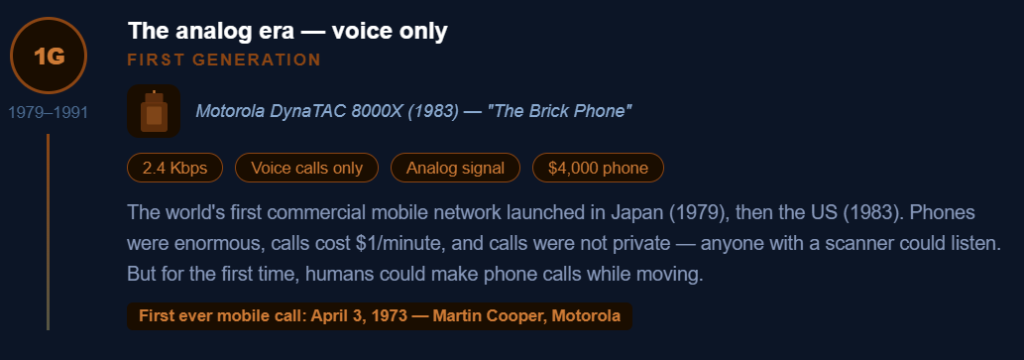
1G — The Beginning (1980s)
Speed: ~2.4 Kbps
What it could do: Voice calls only
Coverage: United States, Japan, Europe
In 1983, the first commercial mobile network launched. It was called 1G — the first generation. It was analog technology. That means it carried voice like a radio wave. You could make phone calls, but that was it. No texts, internet and No photos.
The phones were massive — some were the size of a briefcase. A call could cost over $1 per minute. But, 1G changed the world. For the first time, humans could communicate wirelessly while moving.
The big problem: Calls were not secure. Anyone with the right equipment could listen to your conversation. And the phones only worked in a few countries.
2G — Hello, Text Messages (1990s)
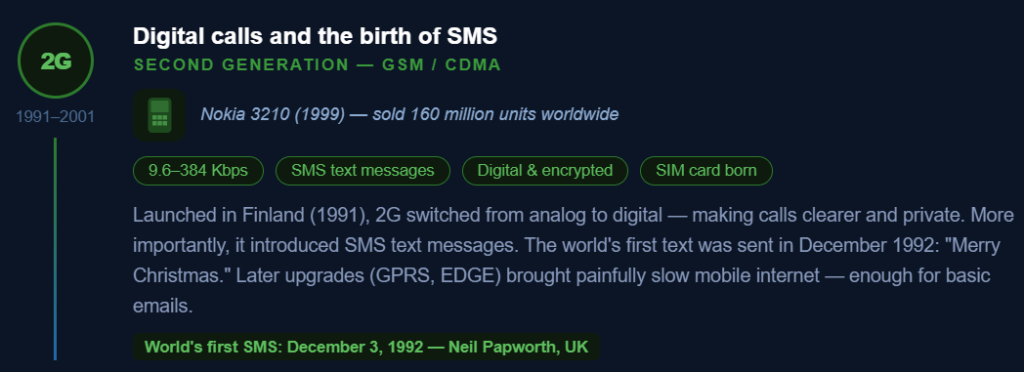
Speed: 9.6 Kbps – 384 Kbps
What it could do: Calls + SMS text messages + basic internet
Launch: Finland, 1991
In 1991, 2G arrived and changed everything.
The biggest difference? 2G was digital. This made calls clearer and more private. More importantly, it introduced something we still use every day: the text message (SMS).
Later in 2G’s life, we got GPRS (2.5G) and EDGE (2.75G), which brought basic mobile internet. You could check emails and use simple websites — slowly. 2G also introduced the SIM card, which let you keep your number when you changed phones.
Fun fact: The world’s first text message was sent in December 1992. It said: “Merry Christmas.”
3G — The Mobile Internet Era (2000s)
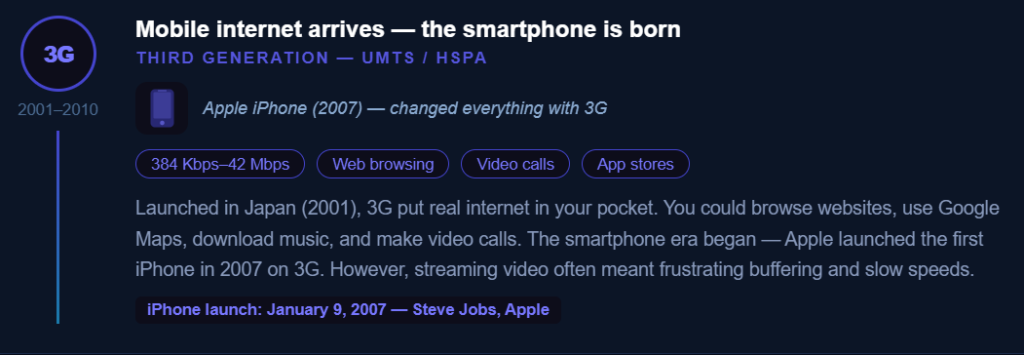
Speed: 384 Kbps – 42 Mbps
What it could do: Web browsing, video calls, apps, music streaming
Launch: Japan, 2001
3G was the generation that put the internet in your pocket. Suddenly, you could browse real websites, use Google Maps, download music, and even make video calls. Apps became popular. The smartphone was born.
In 2007, Apple launched the first iPhone — and 3G made it useful. This was also the era when mobile data plans became a normal thing. Millions of people used the internet on their phones for the first time.
The limitation: Speeds were still slow by today’s standards. Streaming video was frustrating. Buffering was a daily struggle.
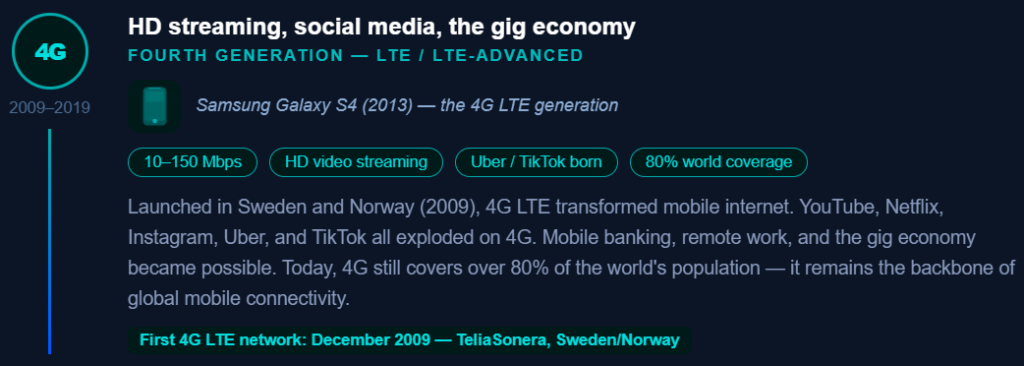
4G LTE — The Streaming Revolution (2010s)
Speed: 10 Mbps – 150 Mbps (peak: 1 Gbps)
What it could do: HD video streaming, HD video calls, mobile gaming, social media
Launch: Sweden & Norway, 2009
4G LTE (Long-Term Evolution) was a massive leap forward.
With 4G, you could:
- Stream YouTube and Netflix without buffering
- Video call in high definition
- Use Instagram, TikTok, Snapchat smoothly
- Work from your phone like a laptop
- Use ride-hailing apps like Uber in real time
4G turned smartphones into productivity machines. It enabled the gig economy, social media influencers, mobile banking, and remote work. Today, most people around the world still use 4G as their daily network. It covers over 80% of the world’s population.
The limitation: 4G struggles in crowded places — stadiums, concerts, busy city centers. When thousands of devices connect at once, speeds drop. And it cannot support the next wave of technology: self-driving cars, smart cities, and billions of connected devices.
That is where 5G comes in.
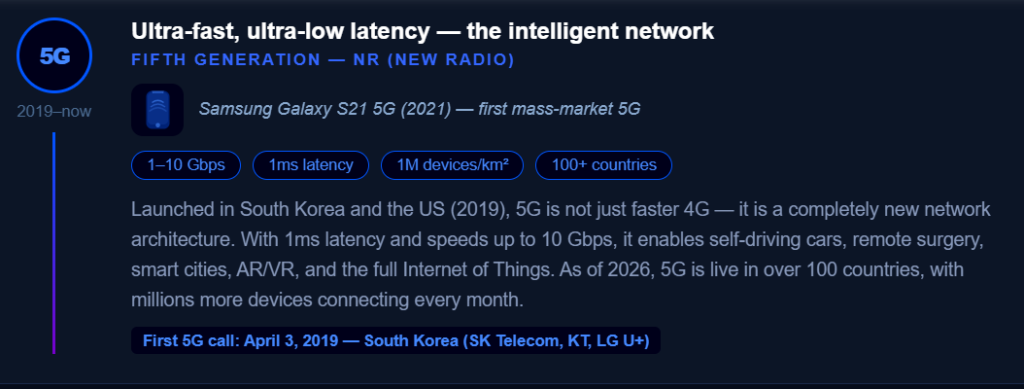
5G — The Network of the Future, Available Today (2019–Present)
Speed: 1 Gbps – 10 Gbps
Latency: As low as 1 millisecond
What it can do: Everything 4G can do, plus: AR/VR, smart cities, self-driving vehicles, remote surgery, massive IoT
Launch: South Korea & United States, 2019
5G is not just a faster 4G. It is an entirely new type of network — built for a world where everything is connected.
How Fast Is 5G Really?
To understand 5G speed, here is a simple comparison:
| Network | Download Speed | Download a 2-Hour Movie |
|---|---|---|
| 3G | ~1 Mbps | ~26 hours |
| 4G LTE | ~20 Mbps | ~6 minutes |
| 5G | ~1,000 Mbps | ~3.6 seconds |
Yes. A full HD movie in under 4 seconds.
What Makes 5G Different?
1. Ultra-Low Latency
Latency is the time between sending a command and getting a response. 4G has about 20–50 milliseconds of latency. 5G reduces this to just 1 millisecond.
This sounds small. But for a self-driving car reacting to a hazard, or a doctor performing remote surgery — that difference can save lives.
2. Massive Connectivity
5G can support up to 1 million devices per square kilometer. 4G can only handle about 2,000. This makes 5G the foundation of the Internet of Things (IoT) — a world where your fridge, car, watch, traffic lights, and factory machines all talk to each other.
3. Network Slicing
5G can split itself into different “slices” for different needs. A hospital’s 5G slice is ultra-reliable. A streaming platform’s slice focuses on speed. A smart factory’s slice prioritizes low latency. One network, many purposes.
Real-World 5G Use Cases
- 🏥 Healthcare: Surgeons in New York operating on a patient in Tokyo using robotic arms controlled via 5G
- 🚗 Transport: Self-driving cars communicating with each other and traffic systems in real time
- 🏭 Manufacturing: Smart factories where machines self-diagnose, adjust, and reorder parts automatically
- 🎮 Gaming: Cloud gaming with zero lag — play AAA games on any device, anywhere
- 🌆 Smart Cities: Connected traffic lights, waste management, energy grids, and emergency services
- 🎓 Education: Immersive AR/VR classrooms accessible from any village with a 5G signal
- 🌾 Agriculture: Sensors and drones monitoring crops, weather, and soil in real time
Where Is 5G Available in 2026?
As of 2026, 5G is live in over 100 countries. Major coverage exists in:
- United States, China, South Korea, Japan
- United Kingdom, Germany, France
- UAE, Saudi Arabia
- Australia, India
However, rural areas in many countries — including parts of Africa, Latin America, and Southeast Asia — are still building 5G infrastructure. This is the digital divide, and closing it is one of the biggest challenges of our time.
5G vs 4G: Quick Comparison
| Feature | 4G LTE | 5G |
|---|---|---|
| Max Speed | ~150 Mbps | ~10 Gbps |
| Latency | 20–50 ms | 1 ms |
| Device Capacity | ~2,000/km² | ~1,000,000/km² |
| Use Case | Smartphones, streaming | IoT, AI, AR/VR, smart cities |
| Energy Efficiency | Standard | Up to 90% more efficient |
| Coverage (2026) | 80%+ of world | ~40% of world |
The Challenges of 5G
5G is powerful, but it is not perfect. Here is what the world is still working on:
1. Coverage Gaps
5G uses high-frequency radio waves (called mmWave) that do not travel far and cannot pass through walls easily. This means more towers are needed — which costs money and takes time.
2. Cost
Upgrading to 5G is expensive — for telecom companies, governments, and consumers. Not everyone can afford 5G phones or data plans.
3. Security
More connected devices means more targets for hackers. 5G networks need strong cybersecurity built into their design.
4. Health Concerns
Some people worry about health effects of 5G radiation. The scientific consensus from WHO and major health bodies: 5G is safe. It uses non-ionizing radiation, similar to 4G and Wi-Fi, which does not damage DNA or tissue.
5. Geopolitical Tension
The 5G race has become political. Countries are debating which companies can build their 5G infrastructure — especially involving Chinese companies like Huawei. This has reshaped global tech alliances.
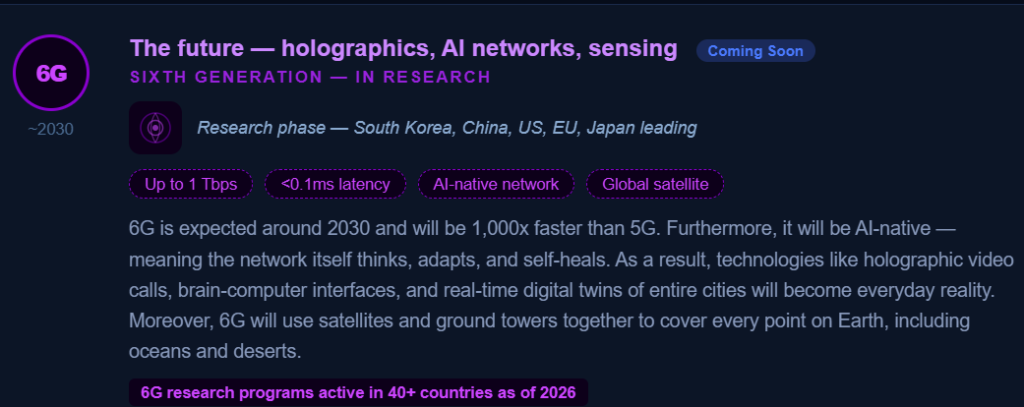
What Comes After 5G? A Look at 6G
While 5G is still rolling out, researchers are already building 6G — the sixth generation of mobile networks.
Expected launch: Around 2030
Here is what 6G is expected to deliver:
- Speed: Up to 1 Terabit per second (Tbps) — 1,000x faster than 5G
- Latency: Less than 0.1 milliseconds — nearly instant
- AI Integration: The network itself will be intelligent — it will predict traffic, fix problems, and optimize itself automatically
- Sensing Technology: 6G will not just connect devices — it will be able to sense the physical environment around it
- Space Coverage: Satellites and ground stations working together to bring coverage to every point on Earth — including oceans and deserts
6G will make technologies we can barely imagine today — holographic calls, brain-computer interfaces, real-time digital twins of entire cities — not just possible, but everyday.
Countries leading 6G research: South Korea, China, United States, Japan, and the European Union.
The Full Timeline: 1G to 6G
| Generation | Era | Key Innovation | Max Speed |
|---|---|---|---|
| 1G | 1980s | Voice calls | 2.4 Kbps |
| 2G | 1990s | Text messages, digital calls | 384 Kbps |
| 3G | 2000s | Mobile internet, apps | 42 Mbps |
| 4G LTE | 2010s | HD streaming, social media | 150 Mbps |
| 5G | 2019–now | IoT, AI, smart cities, AR/VR | 10 Gbps |
| 6G | ~2030 | Holographics, AI networks, sensing | 1 Tbps |
What Does This Mean for You?
If you are a regular person: 5G means faster internet, better video calls, and smarter apps. for business owner: 5G means new ways to automate, track, and serve customers. For a developer or engineer: 5G is an open playground for innovation — from apps to hardware to entire new industries.
Overall, if you live in a developing country: 5G and eventually 6G has the power to leapfrog old infrastructure entirely. Just as many African countries skipped landlines and went straight to mobile, 5G can deliver world-class connectivity without decades of cable-laying.
The network you use today is not the ceiling. It is just the floor.
Frequently Asked Questions (FAQ)
Final Thoughts: We Are Living in a Network Revolution
From a brick-sized phone in 1983 to a world where machines talk to machines, surgeons operate across continents, and cities think for themselves — this is the story of mobile networks.
Each “G” was not just a faster number. It was a new chapter in human history. 1G gave us mobility. 2G gave us connection. 3G gave us the internet in our hands. 4G gave us the streaming age. And 5G is giving us the intelligent world.
The best part? We are just getting started.
At Latestechn, we cover the technologies that are reshaping how we live, work, and connect. Bookmark us because the next generation is always coming faster than you think.
Was this guide helpful? Share it with someone who still thinks 5G is just a faster Wi-Fi. 😄
Have a question about 5G or future networks? Drop it in the comments below — we read every one.
Related Posts You May Like:
- Analogue 3D Finally Gets Save States: Everything You Need to Know About Memories
- OpenAI Keeps Reshuffling Its Executives
- Pope Leo XIV Creates AI Study Group — What It Means for Technology Ethics
- X Finally Fight Hate and Terror Content in the UK