
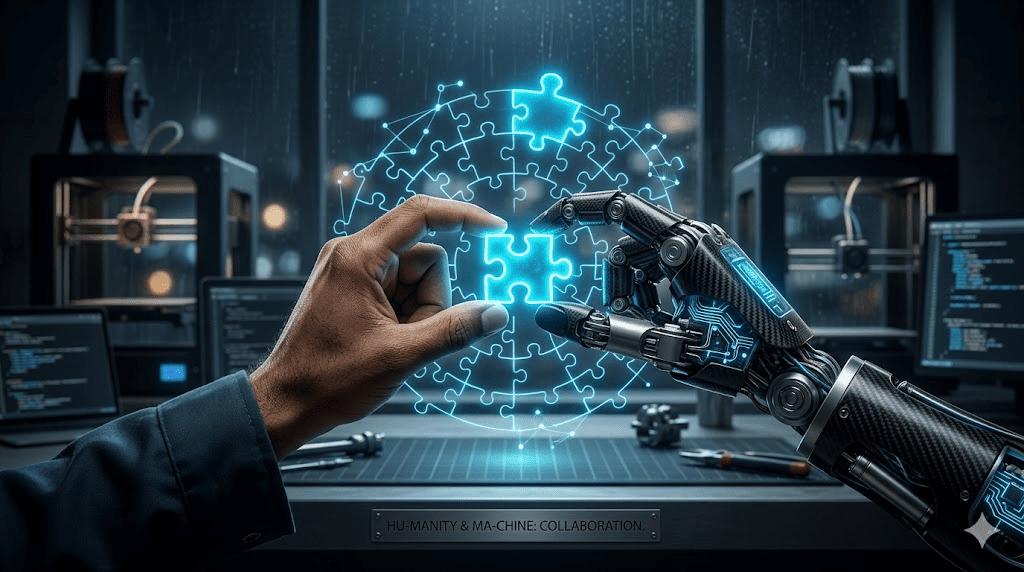
The year 2026 has brought a definitive shift in the global workforce. We have moved past the era of “AI as a novelty” and into the era of “AI as a coworker.” For many, this transition feels like a threat. Headlines often shout about mass automation and the disappearance of traditional roles. However, the reality on the ground is more nuanced. While AI is certainly automating tasks, it is not necessarily replacing people it is replacing the version of people who refuse to adapt.
To stay “safe” in this new economy, you don’t need to compete with AI on speed or data processing; you need to master the skills that AI cannot replicate. These are the “Human-Centric” capabilities that turn an AI threat into a powerful career advantage.
1. High-Level Strategic Thinking
AI is excellent at executing a plan, but it is remarkably poor at deciding which plan is worth executing. Strategic thinking involves understanding the “big picture,” identifying long-term goals, and navigating complex competitive landscapes. Businesses in 2026 are looking for leaders who can look at AI-generated data and say, “This is what the data shows, but here is the creative direction we need to take to truly disrupt the market.”
2. Emotional Intelligence (EQ) and Empathy
Machine learning models can simulate conversation, but they do not “feel.” In fields like healthcare, education, and management, the human element is irreplaceable. The ability to sense frustration in a client, provide genuine comfort to a patient, or motivate a discouraged team is a premium skill. As technical tasks become automated, “soft skills” have become the new “hard skills.”
3. AI Orchestration and Prompt Engineering 2.0
Being “safe” from AI doesn’t mean ignoring it; it means becoming the conductor of the orchestra. In 2026, basic prompting is common knowledge. The elite skill is Orchestration—the ability to string together multiple AI agents, specialized tools, and human workflows to solve a massive problem. If you can manage a digital workforce of AI agents to produce results that used to take a team of ten, your value to a company becomes astronomical.
Read How sell Prompt
4. Critical Thinking and Fact-Verification
As we move further into the age of AI-generated content, the internet is becoming flooded with misinformation and “hallucinations.” A critical skill for the modern professional is the ability to audit AI output. Companies need “Truth Officers”—individuals who can verify the accuracy of AI-generated research, ensure ethical compliance, and spot the subtle errors that automated systems often overlook.
5. Complex Problem Solving in “Grey Areas”
AI thrives in binary environments where there is a clear “right” and “wrong” based on historical data. However, human life is full of “grey areas”—situations where the data is incomplete, contradictory, or ethically sensitive. The ability to make sound judgments in these messy, real-world scenarios is a skill that remains firmly in the human domain.
6. Creative Synthesis
While AI can generate “new” images or text, it is essentially remixing its training data. True creativity—the kind that creates entirely new genres, revolutionary business models, or cultural movements—requires a lived human experience. Creative synthesis is the ability to take two completely unrelated ideas and merge them into something the world has never seen before.
7. Ethical Judgment and Governance
As AI takes over more decision-making processes, the need for human oversight has skyrocketed. Who is responsible when an AI makes a biased hiring decision? How do we ensure privacy in an automated world? Professionals who understand AI ethics and can build frameworks for “Responsible AI” are among the most sought-after experts in 2026.
8. Adaptability and Continuous Learning (Metalearning)
The half-life of a technical skill is now shorter than ever. What you learned six months ago might already be obsolete. The most valuable skill you can possess is Metalearning—the ability to learn how to learn. Those who are comfortable being “beginners,” who can quickly pivot to new tools, and who view change as an opportunity rather than a threat, will always have a place in the workforce.
9. Interpersonal Negotiation and Persuasion
AI can present a logical argument, but it cannot build a relationship. Closing a major deal, resolving a conflict between coworkers, or persuading a board of directors to take a risk requires a level of nuance and social intuition that machines simply do not possess. Negotiation is a high-stakes human game.
10. Technical Literacy and Data Intuition
You don’t need to be a data scientist, but you do need to be data-literate. This means understanding how AI models work, what their limitations are, and how to interpret their results without being blinded by them. “Data Intuition” is the ability to look at an AI’s conclusion and instinctively know if something “feels off.”