
AI Research Papers
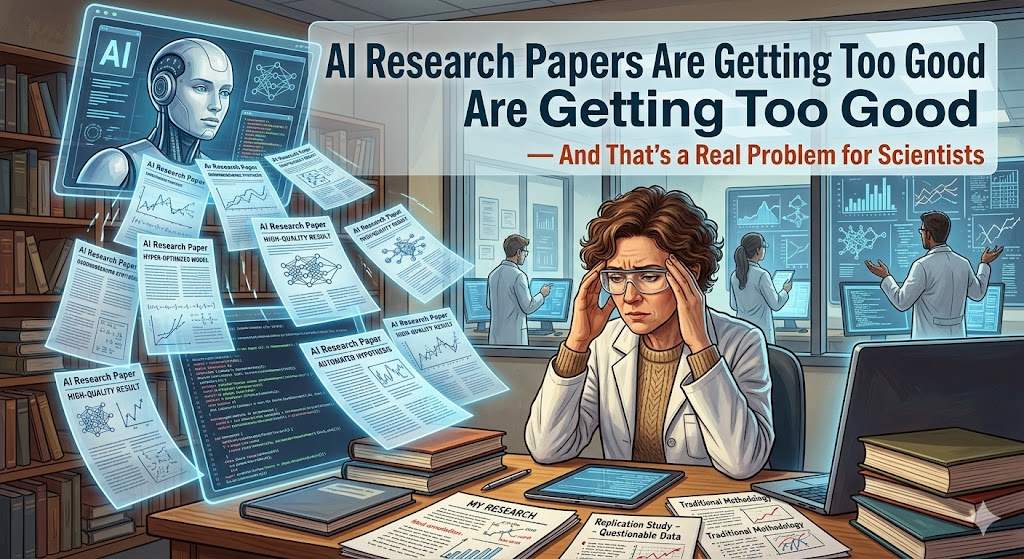
When I first started reading AI-generated research papers, I thought they were impressive. The clean structure, good citations, and clear conclusions stood out immediately. In fact, I genuinely could not tell the difference between a paper written by a human scientist and one written by an AI tool in less than ten minutes.
That moment scared me deeply. My fear didn’t stem from the idea that AI is inherently bad. Instead, I realized the problem wasn’t the writing quality — the problem was that it was simply too good.
This is exactly what we need to talk about today.
The Problem Nobody Is Saying Out Loud
Scientists spend years — sometimes decades — on a single area of research. They design experiments, face failures, and constantly redesign their parameters. By collecting data with careful hands and tired eyes, they eventually write papers that reflect that entire grueling journey.
Now compare that intensive process to an AI tool that can produce a structured, convincing, well-formatted research paper in under an hour. This software requires no lab, no real-world experiments, and no initial peer review of the actual work — just the writing.
This is where the real danger is hiding. The threat lives not in the technology itself, but rather in the growing gap between looking credible and being credible.
A paper that reads like science and a paper that is science are no longer the same thing. Unfortunately, most readers cannot tell the difference anymore.
I have spoken to researchers at universities who say they are already seeing the fallout. Journals are receiving submissions that sound incredibly authoritative but completely fall apart on deeper review. These papers boast perfect grammar, zero spelling mistakes, and conclusions that were never actually tested. While the surface looks exactly right, the foundation remains entirely hollow.
Why This Is Getting Worse, Not Better
Here is what makes this issue so difficult to solve. Because AI writing tools are trained on real scientific papers, they have masterfully learned how to mimic the tone, structure, and citation patterns of legitimate research.

These tools are no longer producing poor text. That was a limitation of 2022. Today, they produce writing that is structurally brilliant because they are trained on the best papers humans ever wrote. Therefore, the problem lies entirely within the data behind the words, not the words themselves.
Volume introduces a secondary issue to the academic world. Back when it was incredibly hard to write a paper, fewer low-quality articles existed simply because the effort required filtered them out. Now that the effort barrier is essentially gone, anyone can flood the publication system with mass-produced content that looks exactly like genuine research.
What This Means for Real Scientists
Let me be personal here, because this matters to me.
My cousin is a clinical researcher who spent three years studying the effects of a specific protein on early-stage Alzheimer’s disease. Those three years were filled with rigorous lab work, complex ethical approvals, patient coordination, and intense data analysis — all to publish one paper. Ultimately, that single paper represents a genuine, hard-earned human contribution to science.
Unfortunately, that paper now sits in a journal alongside hundreds of other publications. Some of these competing articles were generated entirely by AI tools, polished to perfection, and submitted with absolutely no real data behind them. Consequently, her brilliant work is harder to find, causing her true signal to get completely lost in the noise.
This shift represents a trust problem rather than a technology problem. Once trust is broken in the scientific community, rebuilding it becomes incredibly difficult.
My personal take
The damage is not happening at the point of writing. It is happening at the point of reading — when a doctor, a policymaker, or another scientist trusts a paper that was never grounded in real observation.
The Three Ways AI Research Papers Are Changing Science
1. Peer review is breaking down
Peer review was always the gatekeeping mechanism of science. Real experts would read submissions and decide if the work was valid. But peer reviewers are volunteers. They are overloaded. And they were never trained to spot AI-generated text — because two years ago it didn’t matter. Now it does. The system wasn’t built for this speed or volume.
2. Citation ecosystems are getting polluted
AI-generated papers cite real papers. Real papers then sometimes cite back. Before long, fake findings enter the citation web and become treated as established fact. This is already happening in some corners of nutrition science, psychology, and medical research — areas where bad data has real consequences for real people.
3. Junior researchers are under the wrong kind of pressure
Publish or perish has always been a brutal rule in academia. But now junior researchers are competing against machine-level output speed. If your peer submits five papers while you submit one, it doesn’t matter that yours is better. In a system that counts publications, the math is working against honest researchers.
This Is Not About Banning AI
To clear about something, because I think this conversation often goes wrong here. I am not saying AI is bad for science. That is too simple and honestly, it’s wrong.
AI tools are genuinely useful for literature review. They help researchers process massive amounts of data. They assist with translation, accessibility, and formatting. Some of the best uses of AI in science are invisible — running in the background, making good science faster and more thorough.
The problem is not AI helping scientists write. The problem is AI replacing the thing that writing was supposed to represent — actual, verified, human-led inquiry into how the world works.
Using AI to write better is fine. Using AI to fake the work that writing is supposed to prove — that is the crisis.
What Scientists, Publishers, and Readers Can Do
My personal suggestion is not a technology fix. Instead, it represents a fundamental standards fix.
Journals need to require total data transparency. Rather than just a methods section, publications must demand raw data, preregistration, and complete replication packages. If the underlying data is real, the paper is real, since no AI can fake genuinely collected data without it becoming completely obvious on inspection.
Furthermore, peer review desperately needs resources. Reviewers require more time alongside better tools to handle the modern influx of submissions. We simply cannot expect volunteer scientists to catch sophisticated AI fraud on top of their existing workload without any support. Operating this way creates an unfair system that is consistently producing bad outcomes.
Readers — whether you are a scientist, a student, a journalist, or just someone who follows health news — should develop the habit of looking past the abstract. Make sure to ask: where did the data come from? Who collected it? Can I see it? While these questions used to be optional, they are now absolutely essential.
Finally, academic institutions need to rethink publication counts as a primary measure of researcher quality. We must look at impact, value replication, and prioritize depth rather than just sheer volume. If the institutional incentive system stops rewarding volume, the massive flood of shallow AI papers will quickly lose its appeal.
The Bigger Question Behind All of This
There is a deeper question that I keep coming back to. What is a research paper actually for?
If it is a communication tool — a way to share verified knowledge — then its quality depends entirely on what it is communicating. AI can make that communication cleaner and faster. That is a good thing.
But if the paper is also meant to be a record of human effort, human error, human persistence, and human discovery — then something is lost when that record can be generated without the effort, error, and persistence ever having happened.
Science has always been a human endeavor. Messy, slow, sometimes wrong, but fundamentally grounded in people trying to understand reality. The best version of AI in science is one that supports that endeavor. The worst version is one that replaces it with something that only looks like it.
Right now, we are somewhere in between. And where we land depends on choices that scientists, institutions, and publishers are making right now.
Almost most scientists know what the right answer is. The harder question is whether the system around them will let them choose it.