
Honda Hybrid
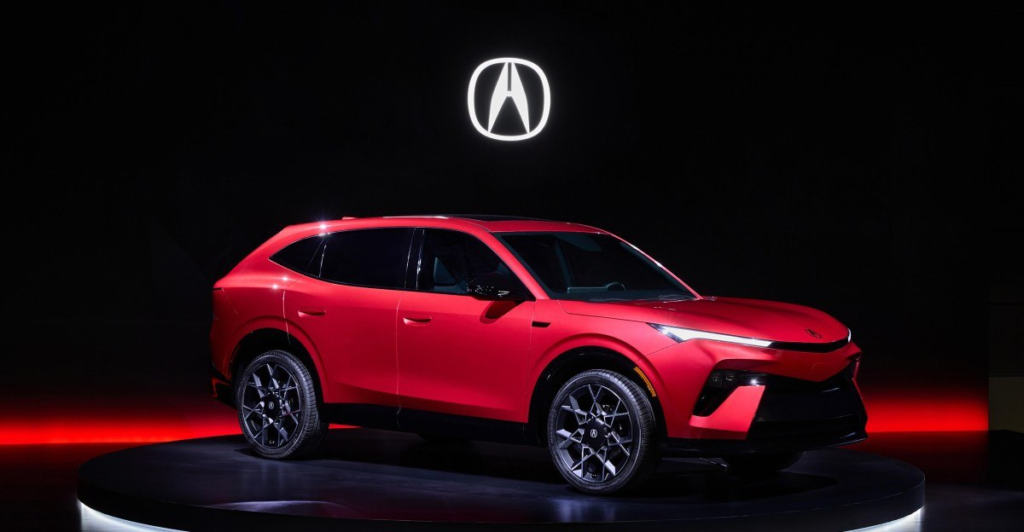
I have followed Honda’s engineering decisions for over a decade. I watched them bet on hydrogen when everyone else went electric. I watched them walk back that bet slowly, quietly, and without much fanfare. And now, in 2026, I am watching something that feels genuinely different — Honda is committing to a hybrid-first future in a way that is not cautious or hedged. The new Accord and RDX prototypes are the clearest signal yet that Honda knows exactly where it is going.
This is not a company that stumbled into hybrid technology. Honda has been building hybrid systems since the original Insight in 1999. What is new is the seriousness of the investment, the sophistication of the architecture, and the fact that they are applying it to two of their most important nameplates at the same time. That is not a test. That is a commitment.
“Honda is not dabbling in hybrid anymore. The Accord and RDX prototypes show a company that has made a firm decision — and built the hardware to prove it.”
Why the Accord and RDX? Why now?
These are not random choices. The Accord is Honda’s best-selling sedan in North America — a nameplate that has survived every automotive trend since 1976 by staying relevant, affordable, and practical. The RDX is Acura’s entry-level SUV, competing directly against the BMW X3, Mercedes GLC, and Audi Q5. Choosing these two vehicles to lead the hybrid push is strategic in a way that matters.
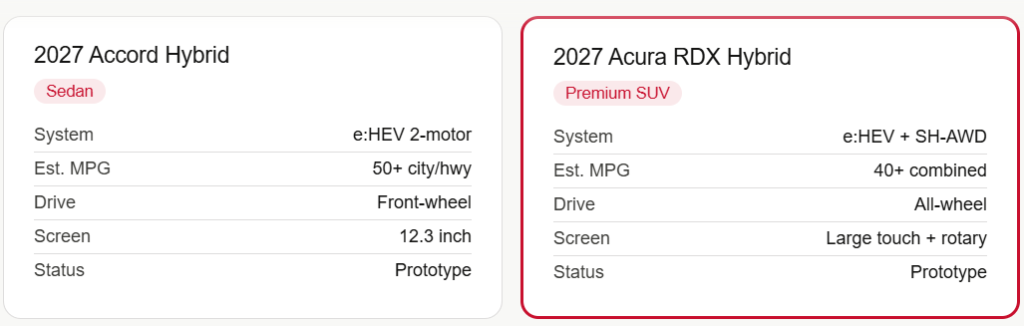
The Accord already has a hybrid variant, and it sells well. But the prototype shown in May 2026 represents a completely new generation of Honda’s e:HEV system — not an update, not a refresh, but a ground-up rebuild of the powertrain architecture. The result is a system that Honda claims produces better fuel efficiency, stronger electric-only range in city driving, and a more responsive power delivery than anything they have made before.
The RDX prototype is the more exciting story for me personally. Acura has never had a strong hybrid story. The brand tried with the SH-AWD hybrid system years ago, but it was complicated, heavy, and expensive to maintain. What I see in the new RDX prototype is a cleaner, simpler approach — Honda’s two-motor hybrid system adapted for the premium SUV segment with proper torque vectoring and a more refined power management strategy.

What the e:HEV system actually does — in plain English
Most car reviews lose people here. They mention kilowatts and regenerative braking and leave readers more confused than when they started. Let me explain what Honda’s two-motor hybrid system does in a way that actually makes sense.
In Honda’s e:HEV setup, the petrol engine is mostly a generator. It runs to produce electricity, which powers the electric motors that actually drive the wheels. In city driving — stop-and-go traffic, low speeds, short trips — the petrol engine often does not engage at all. The car runs entirely on electricity stored in the battery. That is why city fuel economy is so strong. You are not burning petrol in traffic. You are using electricity that was generated when the engine was running efficiently on the motorway.
At higher speeds, the petrol engine can connect directly to the wheels via a lock-up clutch — the most efficient way to cruise on a motorway. The system constantly decides which mode is most efficient for the driving conditions. You do not control it. You just drive, and the car figures it out.
What the new generation adds is a more powerful battery pack, a revised motor layout that improves packaging (making the engine bay less cramped), and a new cooling system for the battery that extends its lifespan significantly. Honda is targeting 200,000 miles of battery durability — a number that matters enormously for resale value and long-term ownership costs.
“The petrol engine in Honda’s e:HEV is mostly a generator. In city traffic, you are often not burning any fuel at all.”
Accord prototype — what is new and what I noticed
The exterior of the Accord prototype is evolutionary rather than revolutionary. Honda has sharpened the front fascia, lowered the roofline slightly, and extended the wheelbase by a small margin to improve rear passenger space. The silhouette is still unmistakably Accord — clean, proportional, and free of the aggressive styling cues that make some competitors look dated within a few years.
Inside, the prototype shows a significantly updated infotainment system built around a 12.3-inch screen that integrates Honda’s new operating system — reportedly developed in partnership with a major software company to address the longstanding complaint that Honda’s in-car software lagged behind its hardware. Wireless CarPlay and Android Auto are standard. The physical controls for climate are retained, which is a decision I genuinely appreciate. Touch-only climate controls are one of the most frustrating trends in modern car design.
The steering feel in the prototype — based on limited early reports from journalists who have sat in the car — is described as more communicative than the current generation. Honda has apparently revised the electric power steering calibration to give better feedback at motorway speeds. This matters for a car that competes against the Toyota Camry and Nissan Altima. The Accord has always had an edge in driving dynamics, and it seems Honda intends to keep that edge.
RDX prototype — Acura’s most important car in years
I want to be direct about something: the RDX is the most important car Acura has made in a long time. The brand has been struggling to define itself against better-established European luxury competitors. A strong, efficient, well-executed hybrid RDX changes that conversation.
The prototype exterior moves Acura toward a more restrained design language. The previous RDX was visually busy — the diamond pentagon grille, the angular body lines, the busy rear. The prototype shown in May 2026 is calmer. The grille is smaller and more integrated. The body surfaces are cleaner. It looks more expensive than its predecessor without trying harder.
The interior of the RDX prototype is where Acura appears to have made the biggest leap. The current generation’s infotainment system — controlled by a touchpad on the centre console — was widely criticised as unintuitive and distracting. The prototype replaces it with a large touchscreen combined with a rotary controller, a layout that offers both the modern touchscreen experience and the tactile control that luxury buyers actually want when they are driving.
Critically, the hybrid system in the RDX prototype includes Honda’s updated SH-AWD — Super Handling All-Wheel Drive — which distributes torque between rear wheels individually. In corners, the outer rear wheel gets more torque than the inner one, effectively pushing the car through the turn rather than fighting understeer. For an SUV in the premium segment, this is a significant handling advantage and one that the German competitors do not match at this price point.
How this fits Honda’s bigger picture
Honda has publicly committed to making all of its new vehicle models fully electric or hybrid by 2040. That is a big statement, and statements are easy. What I look for is evidence in the hardware — real prototypes, real engineering investment, real production timelines. The Accord and RDX prototypes are that evidence.
Honda is not betting exclusively on battery electric vehicles the way some competitors have. They are threading a more pragmatic needle — hybrids now, with stronger electrification as battery technology and charging infrastructure matures. This is not a lack of ambition. It is an honest reading of where the market actually is in 2026. Most buyers in most markets are not ready to commit to a fully electric vehicle as their only car. A 50 MPG Accord hybrid that never needs to worry about charging range is, for a huge number of people, the more practical and more sustainable choice right now.
The Honda Prologue — their electric SUV built on GM’s Ultium platform — showed that Honda can sell EVs when they are well-priced and well-executed. But the Prologue also showed the limits of relying on another company’s platform. The hybrid Accord and RDX are Honda’s own technology, Honda’s own investment, Honda’s own future. That distinction matters for anyone who cares about the long-term health of the brand.
My personal take — should you wait for these?
If you are in the market for a midsize sedan right now and considering the Accord, my honest recommendation is this: if you can wait until late 2026 or early 2027, wait. The current Accord hybrid is already excellent. The next generation, based on what the prototype shows, will be noticeably better in efficiency, technology, and refinement. The jump is meaningful enough to be worth a year’s patience if your current car is reliable.
If you are considering the RDX, the calculus is different. The current generation has known weaknesses — the infotainment system, the slightly dated interior, the lack of a competitive hybrid powertrain. The prototype addresses all three in a meaningful way. If you are shopping in the Acura segment right now, I would hold off unless you need a car immediately. The next RDX looks like it could genuinely compete with the BMW X3 xDrive30e and the Lexus NX 350h — cars that currently outclass it.
For buyers who value efficiency, reliability, and long-term ownership costs over prestige badging, the Accord hybrid has always been one of the smartest purchases in its class. The next generation raises that bar significantly. Honda has earned its reputation for building cars that run well for 200,000 miles without drama. Adding a hybrid system with the same durability target is a compelling ownership proposition that no press release can fully capture — but which every person who has owned a Honda long-term understands instinctively.
Read Bose Promo Code