
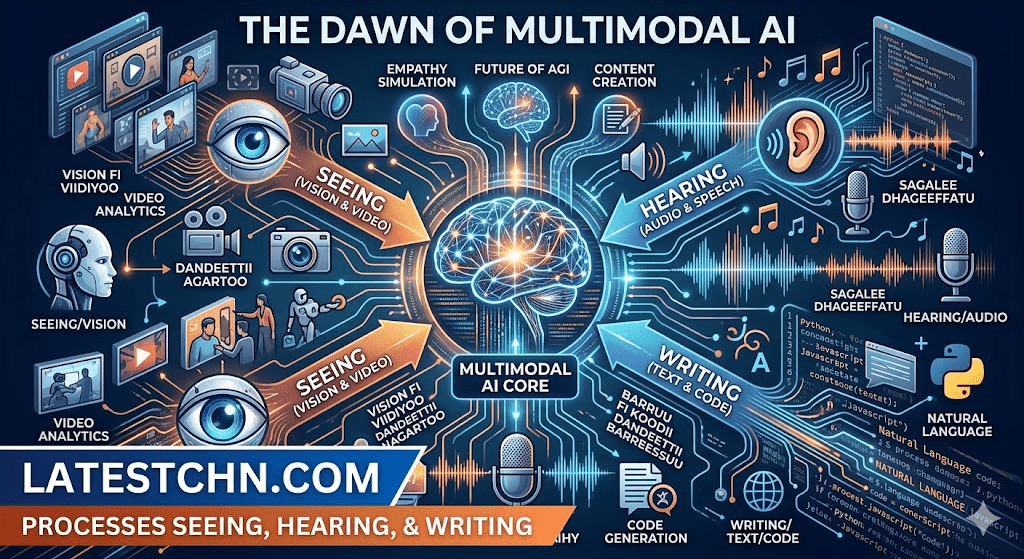
The landscape of Artificial Intelligence has shifted. If 2023 was the year of the Chatbot and 2024 was the year of Video Generation, 2026 is officially the Era of Multimodal Mastery. We are no longer talking to machines that just predict the next word in a sentence; we are interacting with entities that perceive the world much like we do—through a seamless blend of sight, sound, and text.
For tech enthusiasts, developers, and digital entrepreneurs, understanding this shift isn’t just an option—it’s a necessity for survival in the digital economy.
1. What Exactly is Multimodal AI?
To understand the “Why” behind today’s headlines, we must define the “What.” Traditional AI models were unimodal—they processed one type of data (e.g., text-in, text-out). Multimodal AI breaks these silos. It is a type of machine learning that can process and yield output from multiple types of data inputs: text, images, audio, video, and even sensory data.
In 2026, the breakthrough lies in “Native Multimodality.” Instead of training a text model and “plugging in” a vision tool, the newest models are trained on all media types simultaneously. This allows the AI to understand the relationship between a whispered tone of voice and the visual irony in a video clip.
2. The Titans Clash: GPT-5, Gemini 3, and the Open-Source Rebellion
The primary reason this is the “talk of the town” today is the simultaneous release of updates from the world’s leading AI labs.
The Ecosystem Giants
Google’s Gemini 3 and OpenAI’s GPT-5 (and its iterations) have moved beyond mere processing. They now feature “Infinite Context Windows,” allowing users to upload entire libraries of video footage to be analyzed in seconds. Imagine uploading 10 hours of raw drone footage and asking the AI, “Find the exact moment the crop health looks distressed,” and receiving a timestamped report with a generated recovery plan.
The Open-Source Revolution
What’s driving the viral nature of this news is the rise of Llama 4 and other open-source models. For the first time, high-tier multimodality is accessible to independent developers. This democratization means that a local startup in Ethiopia or a freelancer in the US can build “eyes” for their own apps without paying millions in API fees.
3. Real-World Applications: Beyond the Hype
Why are the biggest tech websites obsessed with this? Because it changes every industry it touches.
A. Agriculture 2.0: The AI Agronomist
In regions where agriculture is the backbone of the economy, Multimodal AI is a game-changer. Farmers can now use low-cost smartphones to take a video of their crops. The AI doesn’t just look at a photo; it analyzes the movement of leaves (to detect wind stress), the sound of insects (to identify pests), and the color of the soil to provide real-time irrigation advice.
B. Education: The Teacher that Never Tires
Multimodal AI is creating “Immersive Tutors.” Instead of reading a textbook, a student can show their handwritten math homework to the AI. The AI “sees” the mistake, “speaks” a hint in the student’s native language, and “generates” a 3D visual animation to explain the concept.
C. Content Creation and Freelancing
For creators, the “Video-to-Video” and “Speech-to-Music” capabilities are revolutionary. You can now hum a melody, and the AI will compose a full polka accordion track with a tuba bassline for your TikTok channel—instantly.
4. The “Viral” Factor: Human-Centric Interaction
The reason this topic is currently trending on X (Twitter), LinkedIn, and Reddit is the Emotional Intelligence (EQ) of these new models.
Recent demonstrations show AI models that can detect human emotion through facial expressions via a webcam. If you look confused while the AI is explaining a technical concept, it will automatically slow down its speaking rate and use simpler analogies. This “Empathy Simulation” is both fascinating and controversial, sparking massive debates about the future of human-robot relationships.
5. Technical SEO Deep Dive: Why This Matters for Web Rankings
If you are wondering why your search engine results are changing, it’s because Google’s “Search Generative Experience” (SGE) is now powered by these multimodal engines.
- Visual Search: More people are searching with images than ever before.
- Video Snippets: Google is now able to “watch” your YouTube videos and index the content inside them, even if you don’t provide a transcript.
- Voice Search SEO: As AI voice assistants become more natural, “Long-tail conversational keywords” are replacing short, choppy search terms.
6. Addressing the Elephant in the Room: Ethics and Privacy
We cannot discuss Multimodal AI without addressing the risks. The “Deepfake” problem has evolved. With just 3 seconds of audio and 1 high-resolution photo, AI can now create a “Live Stream” of a person that is indistinguishable from reality.
Major tech hubs are currently debating Digital Watermarking. Every piece of AI-generated content—be it a song, a video, or an article—must now carry a “SynthID” or a cryptographic signature to prove its origin. This friction between innovation and regulation is a primary driver of tech news today.
7. The Future: Toward AGI (Artificial General Intelligence)
Many experts argue that Multimodal AI is the final bridge to AGI. By learning to understand the world through all senses, the AI is beginning to develop a “World Model.” It understands gravity, it understands cause and effect, and it understands human social cues.
We are moving from a world where we “use” computers to a world where we “collaborate” with them.
8. Conclusion: How You Can Prepare
The Multimodal revolution is not just for software engineers; it’s for everyone.
- For Business Owners: Start looking into how visual AI can automate your quality control.
- For Creators: Embrace tools that allow you to mix media types effortlessly.
- For Students: Learn the art of “Multimodal Prompting”—learning to guide an AI using images and voice together.
The era of the “Silent AI” is over. The future is loud, visual, and incredibly fast. Stay tuned to latestechn.com as we continue to track these shifts in real-time.