
Quantum Computing and the Future of Cybersecurity
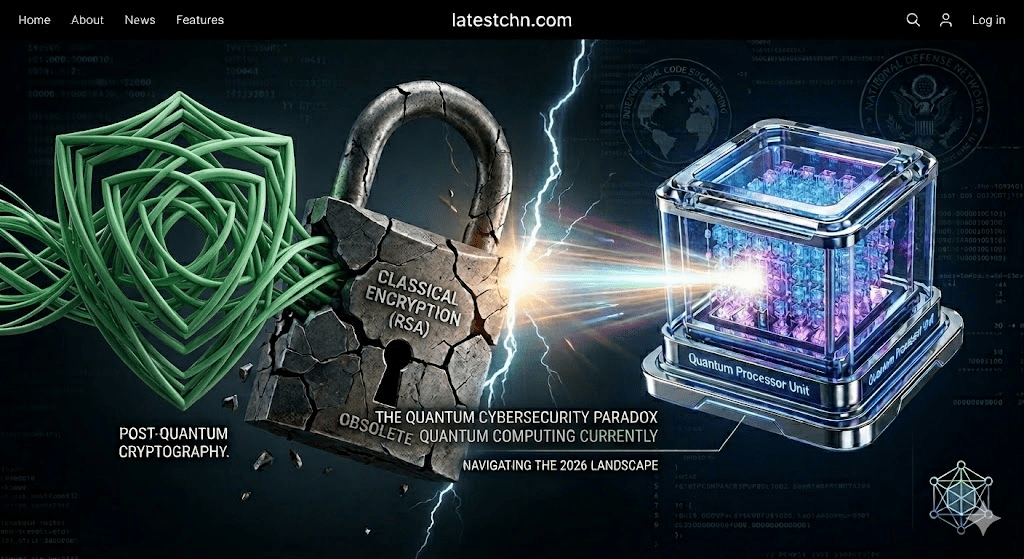
As we move through 2026, the tech world is no longer just talking about Artificial Intelligence. The most significant shift in the architectural foundation of the internet is happening beneath the surface: the rise of Quantum Computing. For years, quantum power was a theoretical concept confined to research labs, but today, it has become a practical reality that threatens the very core of digital privacy.
At latestechn.com, we are tracking how this “Quantum Leap” is forcing a total overhaul of Cybersecurity, creating what experts call the “Post-Quantum” era.
1. Understanding the Quantum Threat: Why Your Passwords are at Risk
To understand why this is the headline of the day, we must look at how traditional encryption works. Most of the world’s digital security—from your bank account to your WhatsApp messages—relies on mathematical problems that are too difficult for classical computers to solve in a reasonable timeframe.
The Shor’s Algorithm Factor
Quantum computers operate on qubits, which allow them to perform millions of calculations simultaneously through superposition. A powerful enough quantum computer can use Shor’s Algorithm to crack RSA and ECC encryption—the two pillars of modern security—in minutes. What would take a traditional supercomputer 10,000 years to solve, a quantum computer can “read” almost instantly.
2. The Rise of “Post-Quantum Cryptography” (PQC)
Today’s major headline revolves around the global transition to Post-Quantum Cryptography. This isn’t just a software update; it is a fundamental change in how data is locked.
The New Standards
The National Institute of Standards and Technology (NIST) has finalized the first set of quantum-resistant algorithms. These are mathematical puzzles that even a quantum computer cannot solve efficiently.
- Lattice-based Cryptography: These algorithms hide data within complex multi-dimensional grids.
- Hash-based Signatures: Using one-way functions to ensure that even if a quantum machine sees the output, it cannot work backward to find the key.
For website owners and developers, integrating these PQC libraries is no longer optional—it is the only way to future-proof your digital assets.
3. Quantum Key Distribution (QKD): Unhackable Communication
While quantum computers are the “threat,” quantum physics also provides the “shield.” Quantum Key Distribution (QKD) uses the laws of physics—specifically the behavior of light particles (photons)—to send encryption keys.
The unique viral aspect of QKD is that it is physically impossible to intercept. According to the “Observer Effect” in quantum mechanics, if a hacker tries to “look” at the data while it is moving through a fiber-optic cable, the quantum state of the particles changes instantly. The sender and receiver are immediately alerted to the breach, and the data becomes useless to the intruder.
4. Why This Matters for Ethiopia and Regional Tech Hubs
Localized platforms like latestechn.com are vital because the “Quantum Divide” could create a new gap in global security.
- Financial Security: Banks in emerging markets must begin migrating to quantum-resistant servers to protect national wealth from “harvest now, decrypt later” attacks—where hackers steal encrypted data today, waiting for quantum computers to become powerful enough to open it in a few years.
- Infrastructure: Power grids, telecommunications, and government databases are all targets. 2026 marks the year that regional tech strategies must include quantum-resilience.
5. The Business of Quantum: Opportunities for Freelancers and Startups
The shift to quantum-safe security is creating a massive new market for tech professionals.
- Security Audits: There is a growing demand for experts who can scan existing systems for “quantum-vulnerable” code.
- Consultancy: Businesses need guidance on how to transition their cloud storage to PQC-compliant providers.
- Educational Content: As we’ve seen with our work in Afaan Oromoo and Amharic tech education, there is a huge need to explain these complex topics to the next generation of African developers.
6. Quantum Computing in 2026: Beyond Security
While security is the “hottest” topic, quantum computing is also revolutionizing other fields that we cover here:
- Agriculture: Quantum simulations are helping scientists create new types of fertilizers that are 10x more efficient, which could transform farming in Ethiopia.
- Medicine: Quantum machines can simulate molecular structures to find cures for diseases in weeks rather than decades.
7. The “Q-Day” Countdown: Are We Ready?
“Q-Day” is the predicted date when quantum computers will be powerful enough to break all current encryption. While some experts predicted this was decades away, the breakthroughs of early 2026 have moved the timeline closer.
The consensus in the tech community is clear: The time to act is now.