
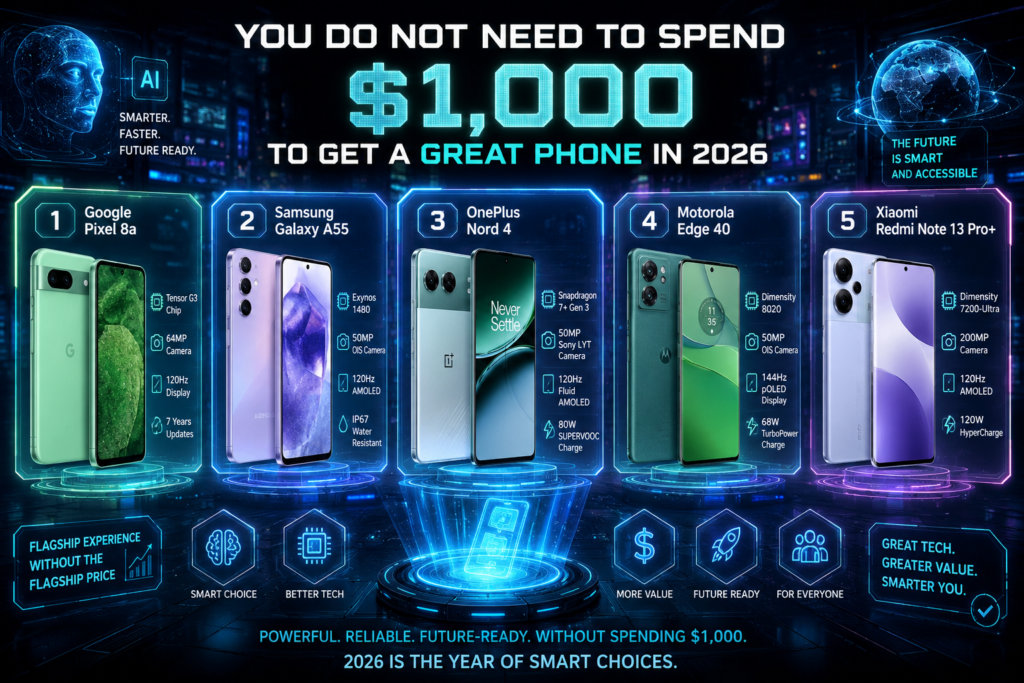
You Do Not Need to Spend $1,000 to Get a Great Phone in 2026
There is a myth in the smartphone world that still refuses to die, the idea that unless you are spending top dollar on a flagship phone, you are somehow settling for a second-rate experience.
That myth has never been less true than it is in 2026.
The mid-range and budget Android phone market has quietly become one of the most exciting spaces in consumer tech. Manufacturers like Google, Samsung, Motorola, Xiaomi, and OnePlus are packing genuinely impressive features into phones that cost under $400 features that would have been flagship-only two or three years ago.
We are talking about excellent cameras, clean software, fast processors, long battery life, and solid build quality. All for less than the price of a weekend trip.
I have spent serious time with the best options in this price range in 2026, and in this article I am going to rank and review them honestly. No sponsored opinions. No vague praise. Just a real breakdown of what each phone does well, what it does not, and who it is best suited for.
Let’s get into it.
What to Look for in an Android Phone Under $400
Before I give you the list, let me quickly outline what actually matters when shopping in this price range because not everything that sounds impressive in a spec sheet translates to a good real-world experience.
Processor: The chip inside the phone determines how fast apps open, how smooth scrolling feels, and how long the phone stays usable as it ages. In 2026, look for Snapdragon 7-series, Dimensity 7000-series, or Google’s Tensor G4 chips in this price bracket. Avoid anything older than two generations.
Battery life: This is the most underrated spec in any phone review. A phone with a 5,000mAh battery that lasts a full day with moderate use is worth more to most people than a slightly better camera that runs out of charge by 4pm.
Camera: In this price range, cameras vary enormously. A single good camera lens beats three mediocre lenses every time. Look at sample photos, not just megapixel counts.
Software support: How long will this phone receive updates? A phone that gets three years of Android updates protects your investment far better than one that stops getting security patches after 18 months.
Build quality: Does it have an IP rating for water resistance? Is the display glass reinforced? These things matter when you are carrying something in your pocket every day.
With those criteria in mind, here are the best Android phones under $400 in 2026.
1. Google Pixel 8a price
Price: ~$349 (US) / varies by region Storage/RAM: 128GB / 8GB RAM Display: 6.1-inch OLED, 120Hz Battery: 4,500mAh Camera: 64MP main + 13MP ultrawide Software Updates: 7 years of Android and security updates
If you only read one entry on this list, make it this one. The Google Pixel 8a is, in my opinion, the single best smartphone you can buy under $400 in 2026 and it is not particularly close.
Here is why. Google’s Tensor G3 chip (carried over from the Pixel 8 series) is efficient and fast enough for everything most people do. The OLED display at 120Hz is genuinely beautiful, better than what you will find on most phones at this price. And the camera is outstanding.
The Pixel camera system uses computational photography to squeeze results out of a 64MP sensor that rival phones charging twice the price struggle to match. Night photography in particular is exceptional. Portrait mode looks natural rather than artificial. Video is smooth and well-exposed.
But the real reason I recommend the Pixel 8a above everything else in this price range is the software. You get seven years of guaranteed Android OS and security updates. That means a phone you buy today in 2026 will still be receiving updates in 2033. No other Android manufacturer in this price bracket comes close to that commitment. It makes the Pixel 8a one of the best long-term value purchases in consumer tech right now.
Who should buy it: Anyone who wants the best overall experience, cares about camera quality, values software longevity, and wants a compact phone.
The downside: The battery is smaller than competitors (4,500mAh), and fast charging tops out at 18W — slower than most rivals.
2. Samsung Galaxy A55 price
Price: ~$349 (US) Storage/RAM: 128GB / 8GB RAM Display: 6.6-inch Super AMOLED, 120Hz Battery: 5,000mAh Camera: 50MP main + 12MP ultrawide + 5MP macro Software Updates: 4 years OS, 5 years security
Samsung’s Galaxy A-series has long been the go-to recommendation for people who want the Samsung experience without the flagship price. The Galaxy A55 in 2026 continues that tradition with a genuinely premium-feeling device.
The display is the standout feature. At 6.6 inches with Samsung’s Super AMOLED panel, colors are vivid, blacks are deep, and the 120Hz refresh rate makes everything feel fluid. If you spend a lot of time-consuming content on your phone YouTube, Netflix, social media the A55’s screen will make you happy every single day.
The build quality is also notably good. The frame is aluminum, the back is glass, and Samsung has included an IP67 water and dust resistance rating meaning this phone can survive a dunk in up to 1 meter of water for 30 minutes. That level of protection at this price is still not a given, and Samsung deserves credit for including it.
The camera system is competent rather than exceptional. The 50MP main sensor takes good photos in daylight, decent ones indoors, and acceptable ones at night. It is not going to make you feel like a professional photographer, but it will not embarrass you either.
Who should buy it: Samsung ecosystem users, content consumers who care about display quality, and anyone who wants a phone that feels and looks premium without paying flagship prices.
The downside: Samsung’s One UI software includes more pre-installed apps than some people want, and four years of OS updates is weaker than Google’s seven-year promise.
3. OnePlus Nord 4 price
Price: ~$329 (US) Storage/RAM: 256GB / 12GB RAM Display: 6.74-inch AMOLED, 120Hz Battery: 5,500mAh Camera: 50MP main + 8MP ultrawide Software Updates: 3 years OS, 4 years security
OnePlus built its reputation on delivering near-flagship performance at mid-range prices, and the Nord 4 continues that tradition convincingly.
What jumps out immediately with the Nord 4 is how fast it feels. The Snapdragon 7+ Gen 3 chip combined with 12GB of RAM makes this phone snappier in day-to-day use than most phones in its price class. Apps open fast, multitasking is smooth, and demanding games run without lag. If raw performance is your priority, the Nord 4 punches significantly above its weight.
The 5,500mAh battery is another highlight. Heavy users can comfortably get through a full day and then some on a single charge. And OnePlus’s 80W SUPERVOOC fast charging means you can go from empty to 50% in roughly 20 minutes one of the fastest charging speeds available in this price range.
The camera is decent but not the phone’s strong point. OnePlus has historically deprioritized camera software compared to Google and Samsung, and that shows in low-light performance particularly. The photos are fine sometimes very good but you will notice the gap compared to a Pixel 8a in trickier lighting conditions.
Who should buy it: Power users, gamers, anyone who prioritizes speed and battery life, and people who hate waiting for their phone to charge.
The downside: Camera software trails Google and Samsung, and OxygenOS (OnePlus’s Android skin) feels different enough from stock Android that it takes some adjustment.
4. Motorola Edge 40 read
Price: ~$299 (US) Storage/RAM: 256GB / 8GB RAM Display: 6.55-inch pOLED, 144Hz Battery: 4,400mAh with 68W charging Camera: 50MP main + 13MP ultrawide Software Updates: 3 years OS, 4 years security
Motorola has quietly become one of the most consistent brands in the mid-range Android market. The Edge 40 is a slim, lightweight phone with a beautiful curved 144Hz display the smoothest refresh rate on this list and a near-stock Android experience that Motorola fans love for its cleanliness.
At $299, the Edge 40 is the most affordable phone on this list, and the value it delivers at that price is remarkable. The display alone would be noteworthy on a phone costing $100 more. The 68W fast charging is excellent top up in about 45 minutes from dead. And Motorola’s software is some of the least bloated in the Android world, which means faster updates, smoother performance, and less nonsense eating your storage.
The camera is the weakest point on the Edge 40. It handles daylight photography well enough, but it struggles significantly in low light compared to the Pixel and Samsung options. If night photography matters to you, look elsewhere.
Who should buy it: Budget-conscious buyers, people who hate bloatware, anyone who values a clean Android experience and a slick display, and Motorola loyalists.
The downside: The weakest camera on this list in low-light conditions, and the curved display edges can sometimes register accidental touches.
5. Xiaomi Redmi Note 13 Pro+ Price
Price: ~$370 (varies by region) Storage/RAM: 256GB / 12GB RAM Display: 6.67-inch AMOLED, 120Hz Battery: 5,000mAh with 120W charging Camera: 200MP main + 8MP ultrawide + 2MP macro Software Updates: 3 years OS, 4 years security
Xiaomi’s Redmi Note series has always been about delivering maximum spec for minimum cost, and the Note 13 Pro+ takes that philosophy to its logical extreme with a 200-megapixel main camera sensor something that was flagship territory just two years ago.
Now, I want to be transparent here: megapixel count is not everything in camera quality. But Xiaomi’s image processing has matured considerably, and the Note 13 Pro+ takes genuinely impressive photos especially in good lighting. The level of detail you can capture and then crop into is striking.
The 120W fast charging is the other jaw-dropping spec on this phone. From zero to full in about 19 minutes. That is not a typo. It charges faster than almost anything else available at any price point. If you forget to charge your phone overnight regularly, this feature alone might be worth the purchase.
Who should buy it: Camera enthusiasts on a budget, people who want maximum specs for the money, and anyone who fast charging is a non-negotiable priority.
The downside: MIUI (Xiaomi’s Android skin) is feature-heavy and includes ads in the stock apps in some regions something that irritates many users. Software update support is also not as long as Google or Samsung.
Head-to-Head Comparison
| Phone | Price | Best Feature | Camera | Battery | Updates |
|---|---|---|---|---|---|
| Google Pixel 8a | $349 | Best camera + 7yr updates | ⭐⭐⭐⭐⭐ | ⭐⭐⭐ | ⭐⭐⭐⭐⭐ |
| Samsung Galaxy A55 | $349 | Display + build quality | ⭐⭐⭐⭐ | ⭐⭐⭐⭐ | ⭐⭐⭐⭐ |
| OnePlus Nord 4 | $329 | Performance + fast charge | ⭐⭐⭐ | ⭐⭐⭐⭐⭐ | ⭐⭐⭐ |
| Motorola Edge 40 | $299 | Value + clean software | ⭐⭐⭐ | ⭐⭐⭐⭐ | ⭐⭐⭐ |
| Xiaomi Redmi Note 13 Pro+ | $370 | 200MP camera + fastest charge | ⭐⭐⭐⭐ | ⭐⭐⭐⭐ | ⭐⭐⭐ |
Which One Should You Buy?
Here is the simple decision guide:
- Best all-around pick → Google Pixel 8a. If you want the best combination of camera, software, and long-term support, this is the one.
- Best for display lovers → Samsung Galaxy A55. That AMOLED screen and premium build are genuinely hard to beat at this price.
- Best for performance and gaming → OnePlus Nord 4. Fastest chip and best charging speed for heavy users.
- Best on a tight budget → Motorola Edge 40. Incredible value at $299 with clean software.
- Best camera specs → Xiaomi Redmi Note 13 Pro+. 200MP and ultra-fast charging if you can handle MIUI.
Final Thoughts: The Under $400 Market Has Never Been Better
Spending under $400 on an Android phone in 2026 used to mean making serious compromises. That is genuinely no longer true. Every phone on this list is fast enough, capable enough, and polished enough to satisfy the vast majority of smartphone users.
The sweet spot for most people is the Google Pixel 8a the combination of camera quality, software cleanliness, and seven years of updates makes it exceptional value. But depending on your priorities, every option on this list has something compelling to offer.
The best phone is the one that fits your life. Use this guide to figure out which one that is and stop feeling like you need to spend $1,000 to have a great smartphone experience. You really do not.
FAQ
Also Read:
- iPhone 18 vs Samsung Galaxy S26: Which Should You Actually Buy?
- Foldable Phones in 2026: Are They Finally the Mainstream Choice?
- 6 Android Settings Most People Have Never Touched — But Should
- Latest Technology Reshape the World
- From 1G to 5G Network and Beyond
Which phone on this list are you considering? Drop your questions in the comments and I will help you decide.