
EU Climate Policy: Shaping the Future of a Carbon-Neutral Continent
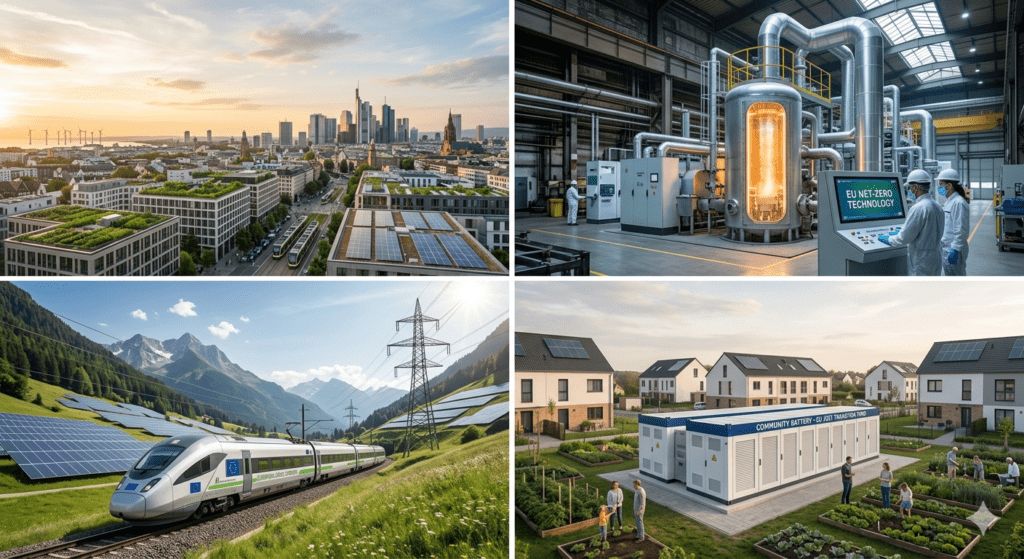
The European Union (EU) has positioned itself as a global leader in the fight against climate change. Through a series of ambitious legislative packages and visionary frameworks, the EU is not just aiming to reduce its environmental impact but is fundamentally redesigning its economy. In 2026, we stand at a critical juncture where policy meets practice, transforming how Europeans live, work, and invest.
This article explores the core pillars of the EU Climate Policy, the milestones of the European Green Deal, and the vast economic opportunities emerging from this “Green Revolution.”
1. The European Green Deal: The Roadmap to 2050
At the heart of EU climate action is the European Green Deal. Launched with the goal of making Europe the first climate-neutral continent by 2050, it is more than just an environmental policy—it is a new growth strategy.
Key Objectives:
- Climate Neutrality: Achieving net-zero greenhouse gas emissions by 2050.
- Economic Decoupling: Ensuring economic growth is decoupled from resource use.
- Leave No One Behind: Utilizing the “Just Transition Mechanism” to support regions and workers most affected by the shift away from fossil fuels.
2. Legal Foundations: The European Climate Law
In 2021, the EU turned its political commitment into a legal obligation through the European Climate Law. As of 2026, the law has been updated to include even more precise intermediate targets:
- 2030 Target: A binding reduction of net greenhouse gas emissions by at least 55% compared to 1990 levels (often called the “Fit for 55” package).
- 2040 Target: A newly adopted target to reduce net emissions by 90%, bridging the gap between 2030 and the final 2050 goal.
- Negative Emissions: A commitment that after 2050, the EU will aim to remove more CO2 from the atmosphere than it emits.
3. The Pillars of the “Fit for 55” Package
To reach the 2030 goal, the EU has overhauled its entire energy and climate architecture. The following pillars are the engines of this change:
A. The Emissions Trading System (EU ETS)
The ETS is a “cap and trade” system where companies buy or receive emissions allowances. By putting a price on carbon, the EU incentivizes industries to invest in clean technology. In 2026, this system is expanding to include shipping and aviation, and a new “ETS2” is being phased in to cover buildings and road transport.
B. Carbon Border Adjustment Mechanism (CBAM)
To protect European industries that pay for carbon from being undercut by cheaper, “dirty” imports, the EU introduced CBAM. It acts as a carbon tax on imports like steel, cement, and electricity, ensuring that global trade supports climate goals.
C. The Net-Zero Industry Act
This policy aims to scale up the manufacturing of clean technologies within Europe. Whether it’s solar panels, wind turbines, or heat pumps, the EU is providing faster permitting and financial support to ensure it remains a leader in “Green Tech.”
4. Economic Opportunities: Making the Climate Policy Profitable
For businesses and investors, the EU Climate Policy is not a burden—it is a goldmine of opportunity.
- The Carbon Market Boom: As the price of carbon allowances rises within the ETS, companies that successfully decarbonize can sell their excess credits, turning emission reduction into a direct revenue stream.
- Circular Economy Initiatives: New rules on product durability and recycling (the “Right to Repair”) are creating an entirely new industry focused on refurbishment and sustainable manufacturing.
- Green Finance: Through the EU Taxonomy, the Union has created a classification system for sustainable investments. Companies that meet these green criteria have access to trillions of euros in “Green Bonds” and private capital.
- Innovation Fund: The EU is investing billions into “lighthouse” projects—first-of-their-kind technologies like green hydrogen and carbon capture—that will define the industrial landscape of the 2030s.
5. Challenges and the Path Ahead
While the vision is clear, the transition faces significant hurdles:
- Energy Prices: Moving away from cheap natural gas has led to temporary price spikes, requiring governments to protect vulnerable households.
- Infrastructure: Building the “Super-Grid” needed to transport renewable energy from the windy North Sea to the sunny Mediterranean is a massive engineering task.
- Strategic Autonomy: Reducing dependence on critical minerals (like lithium and rare earths) from external powers is vital for Europe’s security.
Conclusion
The EU Climate Policy is the most ambitious environmental project in human history. By 2026, the framework is largely in place, and the focus has shifted to implementation and innovation. For the global citizen, Europe serves as a living laboratory, proving that a high standard of living can indeed go hand-in-hand with a healthy planet.
The message to the world is clear: The future is green, and the path to prosperity is paved with sustainability.
Read the Romanian Electric Technology : Romania’s Green Energy Leap – NEWS Romania’s Green Energy Leap