
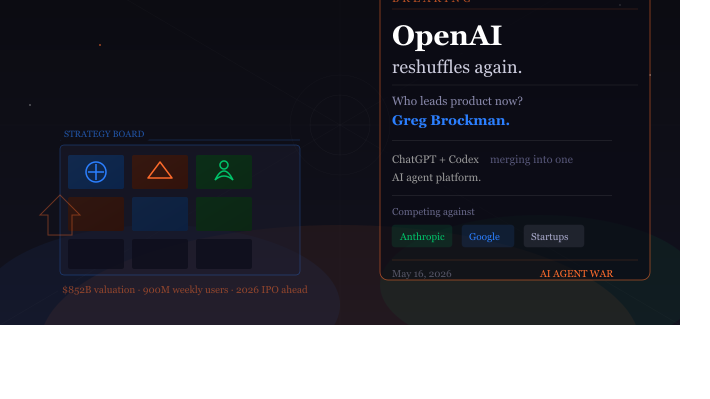
OpenAI just hit the reset button — again. OpenAI executive reshuffle 2026
On Friday, May 15, 2026, the company announced yet another major internal reorganization. This time, it is merging ChatGPT, Codex, and its developer API into one single product team. Co-founder and President Greg Brockman is now officially in charge of all product strategy. And the goal is building the world’s most powerful AI agent platform before anyone else does.
But here is the big question nobody is fully asking yet — how many times can a company reshuffle before the reshuffling itself becomes the problem?
Let me break this down in plain English, give you the full picture of what is happening inside OpenAI right now, and share my honest take on whether this bold move will actually work.
What Exactly Just Happened at OpenAI?
To understand the May 2026 reorganization, you need a little context.
A few weeks ago, OpenAI’s product chief Fidji Simo — the woman who had been driving the company’s “superapp” vision and championing the merge of ChatGPT and other tools into one experience — went on medical leave. Greg Brockman stepped in temporarily to cover her responsibilities.
Then, on May 15, 2026, OpenAI made it official. Brockman is no longer just a temporary stand-in. He is now the permanent head of all product strategy, in addition to his existing role overseeing AI infrastructure. That is a massive amount of power for one person to hold.
In a memo sent to staff and later seen by WIRED and The Verge, Brockman wrote:
“We’re consolidating our product efforts to execute with maximum focus toward the agentic future, to win across both consumer and enterprise.”
OpenAI’s products are “naturally converging” — meaning ChatGPT, Codex, and the developer API no longer make sense as separate teams. They are being merged into one unified product team with one unified mission: build the AI agent platform that the world runs on.
Two other executives are also stepping into bigger roles as part of this reshuffle:
- Thibault Sottiaux, the engineering lead who built Codex into one of OpenAI’s fastest-growing products, will now lead the core product and platform across consumer, enterprise, and developer surfaces.
- Nick Turley, the man who helped grow ChatGPT to over 900 million weekly active users, is shifting focus to revamp OpenAI’s enterprise products — while still staying connected to ChatGPT.
Why Is OpenAI Doing This Right Now?
Here is my honest assessment: OpenAI is scared. Not panicking, but definitely feeling the heat.
The company that invented modern AI chatbots and made “ChatGPT” a household word is now facing the most serious competition it has ever seen. And it is coming from multiple directions at once.
Anthropic: Just a short time ago, Anthropic — the company founded by ex-OpenAI researchers — raised another massive funding round at a $60 billion valuation, specifically to accelerate its AI agent capabilities. Even more stinging: new data from Ramp’s AI Index shows that Anthropic has surpassed OpenAI in workplace AI adoption. Anthropic reached 34.4% business adoption in April 2026, while OpenAI fell to 32.3%. That might sound like a small gap, but it is a psychological earthquake in the AI industry.
From Google: Google’s DeepMind division is pushing hard with its Astra model for enterprise customers. And Google has something OpenAI doesn’t — it controls the world’s largest search engine, YouTube, Chrome browser, and Android operating system. That is an enormous distribution advantage when it comes to getting AI agents in front of everyday users.
Startups: Companies like Adept and Sierra are raising hundreds of millions of dollars specifically to build specialized AI agents for niche industries. They are not trying to be everything to everyone — but they are going deep in specific sectors, which makes them very hard to compete against.
OpenAI’s window to establish itself as the dominant AI agent platform is real, but it is closing. And that is exactly why Brockman is now holding the wheel.
What Are “AI Agents” and Why Does Everyone Want to Win This Race?
The term “AI agents” everywhere and wondering what the fuss is actually about, let me explain it simply. Right now, most people use AI like a smart search engine. You ask ChatGPT a question. Then he gives you an answer.
An AI agent is completely different. Instead of just answering your question, it actually does things for you — automatically, step by step, without you having to guide every move.
Imagine telling an AI: “Book me the cheapest flight from ching to Dubai next weekend, add it to my calendar, email my team that I’ll be out of office, and prepare a summary of my pending work emails so I can handle them before I leave.”
A traditional chatbot would give you instructions on how to do all that yourself. An AI agent would actually do all things — browse flight sites, book the ticket, open your calendar, write and send the emails, read your inbox, and summarize it. All while you make coffee.
This is why every major AI company is racing to win the agent space. Gartner predicts that by 2028, AI agents will be involved in 15% of day-to-day work decisions — up from less than 1% today. That is a market transformation happening at lightning speed. And here is the even bigger picture: whoever builds the platform that AI agents run on top of will control the next era of the internet the same way Amazon Web Services controls cloud computing today. The prize is worth trillions of dollars.
Why Merging ChatGPT and Codex Is the Key Move
Of all the things OpenAI announced, the merger of ChatGPT and Codex is the one I find most interesting and most telling.
ChatGPT is the conversational AI that 900+ million people use every week. Because of this brilliant at understanding what humans want in plain language.
Codex is OpenAI’s AI coding engine. It does not just talk — it acts. By writing, executing, debugging, and deploying code natively, this tool goes far beyond conversation. As a result, this has quickly become one of OpenAI’s fastest-growing products because businesses want AI that can actually build things, not just explain how to build them.
By merging these two, OpenAI is essentially creating a brain that understands language AND can take action. You talk to it like a human. It executes like a machine.
That is the blueprint for a true AI agent. Not just a smarter chatbot. A digital worker.
For developers and businesses already building on OpenAI’s platform, this is actually good news in the long run. It means more coherent APIs, better integration between conversational AI and task execution, and a single platform to build on instead of piecing together different OpenAI products.
The short-term disruption — changes to existing Codex implementations, uncertainty about timelines — is a real pain point. But the destination OpenAI is building toward is genuinely exciting.
The Elephant in the Room: Too Many Reshuffles?
Now, here is my personal take — and I say this as someone who closely watches the AI industry.
OpenAI’s executive reshuffles are starting to look less like strategic pivots and more like an organization still figuring out what it actually is.
Think about what has happened just in the past few months:
- Fidji Simo, the CEO of AGI Development who was hired to build a ChatGPT superapp, went on medical leave.
- Kevin Weil, who led OpenAI’s AI workspace for scientists, departed.
- Bill Peebles, head of the Sora video generation project, left.
- Srinivas Narayanan, the CTO of enterprise applications, also exited.
- Now Greg Brockman is absorbing responsibility for everything product-related.
That is a lot of high-level exits and role changes in a very short window. And while OpenAI’s official statement says they have “a strong leadership team focused on our biggest priorities,” the pattern tells a more complicated story.
Constant reorganization has real costs. Engineers do not know who to report to. Product teams lose momentum. The people doing the actual work — building features, fixing bugs, supporting customers — have to absorb uncertainty and distraction from the top. It creates what insiders sometimes call “organizational chaos.”
I do not think OpenAI is in crisis. This is still a company sitting at an $852 billion valuation with nearly one billion weekly users. Those are staggering numbers. But there is a real risk that the constant shuffling slows down execution at exactly the moment when speed matters most.
The company that wins the AI agent race will not just have the best technology. It will have the most disciplined execution. It will ship faster, fix problems faster, and support its developer community better than anyone else.
Greg Brockman now has the authority to drive that execution. The question is whether he can actually deliver it.
What This Means for You — Whether You’re a User, Developer, or Business Owner
If you are an everyday ChatGPT user: Expect ChatGPT to get significantly more capable over the coming months. The merge with Codex means your AI assistant will gradually become able to take more actions on your behalf not just give advice, but do tasks. Think of it as ChatGPT growing hands.
developer building on OpenAI’s API: There may be some short-term disruption as the product teams merge and APIs evolve. Watch for official announcements about changes to rate limits, pricing, and SDK updates. The good news is that a unified platform should be more powerful and consistent to build on over time.
business evaluating AI tools: This is a moment to pay close attention. The AI agent race is about to produce genuinely transformational tools for business automation. OpenAI, Anthropic, and Google are all racing to win your organization’s AI budget. That competition is healthy it means better tools, more competitive pricing, and faster improvement.
My advice: do not pick a winner yet. The landscape will look very different by the end of 2026. Stay informed, run pilot projects with multiple platforms, and build your team’s AI literacy now because whatever agent platform wins, your team needs to know how to use it.
My Bold Prediction for the Rest of 2026
Here is what I think happens next, based on everything I am seeing:
OpenAI will ship a genuinely impressive unified agent platform by Q3 or Q4 2026. The merge of ChatGPT and Codex, combined with Brockman’s focused leadership, will produce something more powerful than either product was separately.
But Anthropic will not stand still. Claude’s enterprise adoption is already outpacing OpenAI’s in business settings. Claude Code — Anthropic’s coding tool — is growing fast among developers. Anthropic has a reputation for careful, reliable AI that enterprises trust. That reputation is worth a lot.
Google will remain the wild card. The company has distribution advantages that neither OpenAI nor Anthropic can match. If Google Astra launches successfully for enterprise customers, it could disrupt everything overnight.
The real winner might not be decided by technology at all. It will be decided by trust, reliability, pricing, and which platform developers choose to build on. History shows that developer platforms are won by whoever makes it easiest to build — not necessarily whoever has the best underlying technology. (Ask MySpace and Friendster how that works.)
OpenAI knows this, which is why the unified platform strategy makes sense. Making ChatGPT, Codex, and the API feel like one seamless product is a developer experience play as much as it is a technology play.
The Bottom Line
OpenAI’s latest reshuffle is not just corporate housekeeping. It is a public declaration of war in the AI agent battle — a clear signal that the company is done treating ChatGPT and Codex as separate experiments and is now all-in on building the platform that defines the next era of AI.
Greg Brockman now holds the keys to that mission. He is one of the most technically brilliant people in the AI industry and was there from day one when OpenAI was still a scrappy nonprofit with a moonshot idea. If anyone can execute this vision, it is him.
But execution is everything now. The ideas are there. The funding is there — OpenAI just closed a landmark $122 billion round at an $852 billion valuation. The talent, despite some high-profile exits, is still formidable.
What OpenAI needs most right now is not another reorganization. It needs stability, focus, and relentless shipping.
The AI agent war is already happening. The only question is who crosses the finish line first — and whether constant internal reshuffling helps or hurts OpenAI’s chances of getting there.
I will be watching closely. And so should you.
What do you think? Will OpenAI’s unified agent platform win the AI race — or is the constant reshuffling a warning sign? Drop your thoughts in the comments below.
Related posts you might like:
- Anthropic Surpasses OpenAI in Enterprise AI Adoption — What It Means
- What Are AI Agents and Why Every Tech Company Is Racing to Build Them
- Google Astra vs ChatGPT Agents: The Battle That Will Define AI in 2026
Frequently Asked Questions