
Why Foldable Tech and AI Wearables are Redefining Mobility in 2026
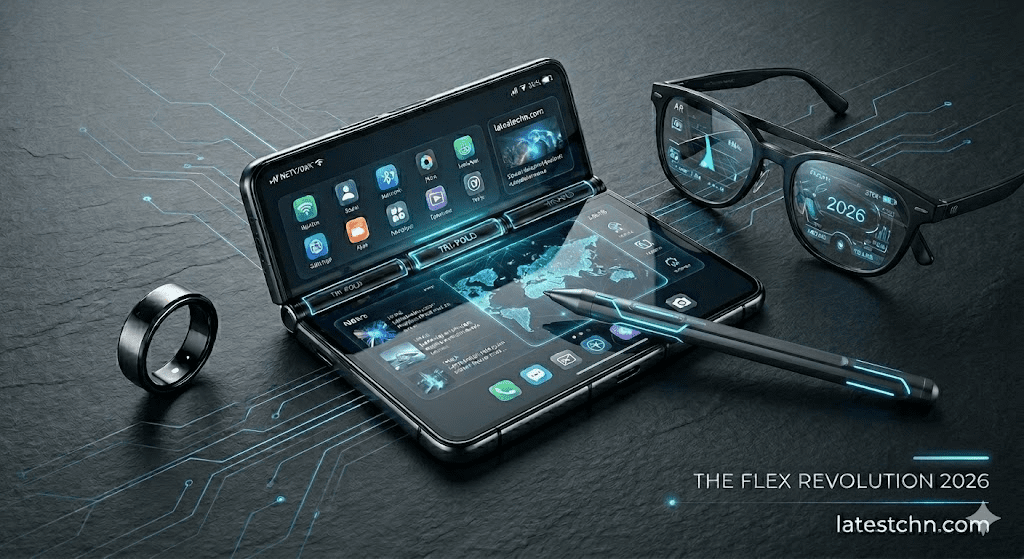
Created by Gemini
For decades, the “black rectangle” smartphone was the pinnacle of design. But as we reach the middle of 2026, a radical shift has occurred. Static screens are being replaced by dynamic, folding displays, and the smartphone itself is facing a challenge from a new generation of AI-powered wearables.
At latestechn.com, we are witnessing the death of the “one-size-fits-all” gadget. We are entering an era of “Adaptive Hardware”—devices that change shape and function based on your immediate needs.
1. The Maturity of Foldable Technology: Beyond the Gimmick
When foldable phones first arrived, they were fragile and expensive. In 2026, the story is different. Breakthroughs in Ultra-Thin Glass (UTG) and carbon-fiber hinge mechanisms have made these devices more durable than traditional “slab” phones.
The Rise of Tri-Folds and Rollables
While the “Fold” and “Flip” styles remain popular, the headline of 2026 is the Tri-Fold smartphone. These devices unfold twice to create a full 10-inch tablet experience that still fits in your pocket. Combined with rollable screen technology—where the display slides out like a scroll—the boundary between a phone, a tablet, and a laptop has completely evaporated.
2. AI-Integrated Wearables: The “Post-Screen” Future
Perhaps even more exciting than folding screens is the move away from screens entirely. We are seeing a surge in AI Wearables—devices designed to be felt or heard rather than looked at.
AI Smart Rings and Pins
Devices like the latest smart rings have moved beyond simple step-counting. They now feature haptic feedback and bone-conduction audio, allowing you to take calls or interact with your AI assistant by simply touching your ear. Meanwhile, “AI Pins” use laser projection to turn the palm of your hand into a temporary screen, allowing you to check notifications without pulling out a device.
Smart Glasses: The New Standard
2026 is the year Augmented Reality (AR) glasses finally became stylish. Unlike the bulky headsets of the past, today’s smart glasses look like standard eyewear but feature micro-LED displays. They provide real-time translation, navigation overlays, and facial recognition cues—integrated directly into your field of vision.
3. The Synergy: Foldables Meet Wearables
The most powerful tech setup in 2026 isn’t just one device; it’s an ecosystem.
- The Hub: Your foldable phone acts as the “brain,” staying in your pocket or bag to handle heavy processing.
- The Interface: Your smart glasses or watch acts as the “eyes and ears,” giving you instant access to information.
This synergy allows for a “Distraction-Free” life. You only unfold your phone for deep work or media consumption; for everything else, your wearables keep you connected to the world around you, not a screen.
4. Health 3.0: Medical-Grade Monitoring on Your Wrist
In 2026, wearables have moved from “fitness trackers” to “medical diagnostic tools.”
- Non-Invasive Glucose Monitoring: A major breakthrough for 2026 is the ability for watches and rings to monitor blood sugar levels using infrared sensors—a life-changing feature for diabetics.
- Stress and Mental Health: Using skin conductance and heart-rate variability (HRV), these devices can now predict a panic attack or high-stress moment before you feel it, suggesting breathing exercises or “focus mode” for your devices.
5. Why This Matters for the Global Market
For a digital content creator or business owner using latestechn.com, these hardware shifts change how content is produced and consumed.
- Responsive Content: Websites must now be optimized for unconventional aspect ratios (square screens, ultra-wide tri-folds).
- Voice and Visual Search: As people use glasses and pins more, optimizing your SEO for voice queries and visual recognition is the only way to stay relevant.
6. Challenges: Battery and Sustainability
The “Flex Revolution” isn’t without hurdles. Folding screens require more power, and the environmental impact of wearable batteries is a major concern. The industry is currently pivoting toward solid-state batteries and “Energy Harvesting” (using body heat or movement to charge your ring), which we expect to be the next big headline.
7. Conclusion: Choosing Your Flex
The future is no longer a single device. Whether you prefer the massive screen of a tri-fold or the invisible convenience of an AI ring, 2026 is about empowerment through choice. Hardware is finally catching up to the speed of our imagination.
Stay ahead of the curve by following our deep-dive reviews and technical guides right here on latestechn.com.
Read Smart Phone
Read More