
Written by: Joel Adam
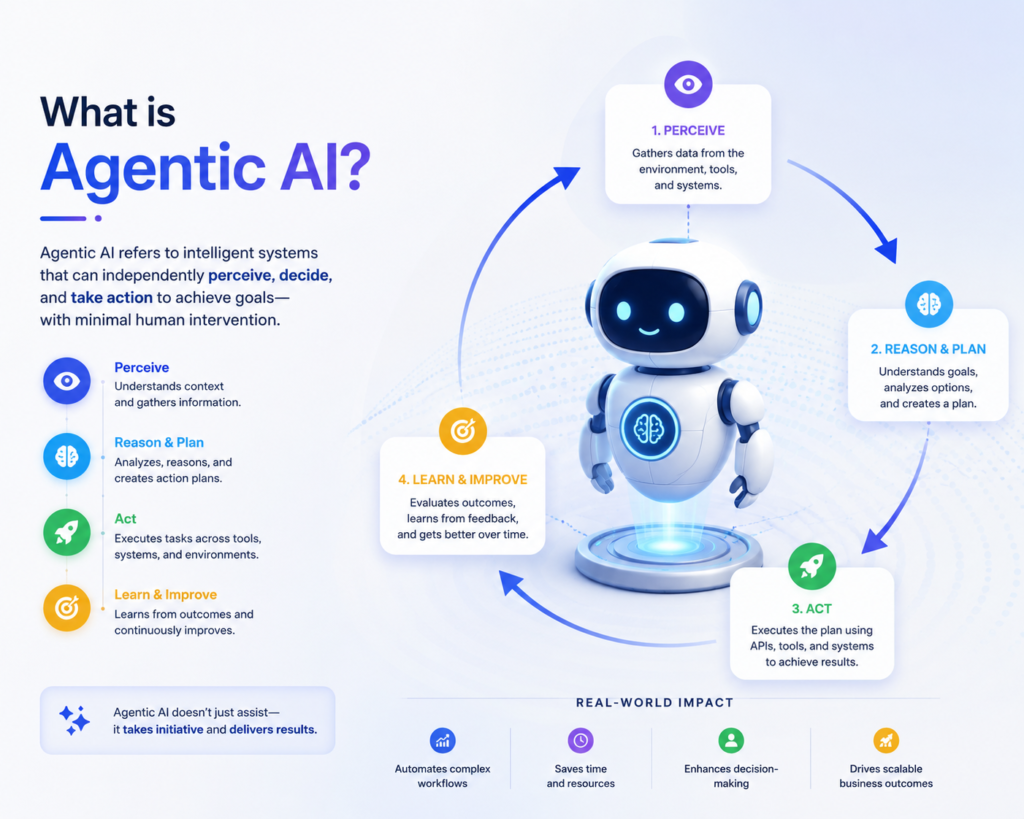
Introduction: AI Is No Longer Just Answering Questions It Is Taking Action
For the past few years, most people understood AI tools in one simple way: you ask, it answers. You type a question, you get a response. You give it a task, it produces an output. Done.
That model is now changing fast. And the change is bigger than most people realize.
Welcome to the age of agentic AI where AI does not just respond to you, it acts on your behalf. It browses the web, fills out forms, writes and runs code, books appointments, manages files, sends emails, and completes multi-step tasks from start to finish without you needing to hold its hand every step of the way.
If that sounds like science fiction, I understand. But it is happening right now, in 2026, and it is already reshaping how businesses operate and how individuals manage their work.
In this post, I want to break down exactly what agentic AI is, how it actually works under the hood, what real examples look like today, and what this shift means for you whether you are a developer, a business owner, a student, or just someone trying to understand where this technology is going.
Let’s start from the beginning.
What Does “Agentic” Actually Mean?
The word “agentic” comes from the concept of an “agent” something that takes action in the world to achieve a goal.
In traditional AI, the model is reactive. It sits and waits. You prompt it, it responds, and the exchange is complete. It does not do anything unless you tell it to, and even then, it only does the one thing you asked.
An agentic AI is different. It is given a goal not just a single instruction and it figures out on its own what steps it needs to take to achieve that goal. It can use tools, browse the internet, write and execute code, call APIs, access your files, and take actions across multiple steps all in pursuit of completing the task you gave it.
Think of the difference between asking a colleague “what is the best hotel in Nairobi under $100?” (reactive) versus telling them “book me a hotel in Nairobi under $100 for next Friday, check the reviews first, and send me the confirmation” (agentic). One answers a question. The other completes a mission.
That is the core of agentic AI.
How Does Agentic AI Actually Work?
To understand agentic AI, you need to understand three core concepts: tools, memory, and planning.
Tools
An AI agent is connected to tools it can use to interact with the world. These might include:
- A web browser (to search and read pages)
- A code interpreter (to write and run code)
- File access (to read, write, and organize documents)
- Email and calendar APIs (to send messages and schedule events)
- External service APIs (to book things, retrieve data, trigger actions in other apps)
When the AI decides it needs to do something — like check today’s news or send an email — it calls the appropriate tool and uses the result to continue working toward the goal.
Memory
Agentic AI needs to remember what it has done so far, what it has learned, and what still needs to be done. This is called memory, and it comes in different forms:
- Short-term memory: what is happening in the current task
- Long-term memory: information stored between sessions (like your preferences or project details)
- External memory: databases and documents the agent can look things up in
Without memory, an agent would forget what it was doing after every single step — which would make it completely useless for anything complex.
Planning
This is the most impressive part. An agentic AI does not just do steps randomly. It breaks down a complex goal into smaller sub-tasks, figures out the right order to do them in, and adjusts its plan when something does not go as expected.
This is called “chain of thought planning” or “task decomposition” in technical terms. In plain English, it means the AI thinks before it acts and keeps thinking as it goes.
Real Examples of Agentic AI in 2026
Enough theory. Let me show you what this actually looks like in the real world right now.
Example 1: Research and Report Writing
Without agentic AI: You spend 3 hours searching Google, reading articles, taking notes, opening 15 tabs, losing track of sources, and then writing a report manually.
With an agentic AI: You type “Research the top 5 electric vehicle companies by sales in 2026, find recent news about each one, and write me a 500-word summary with sources.” The agent searches the web, reads multiple pages, filters out irrelevant information, organizes the findings, and delivers a written summary with citations in minutes.
I have done this myself. It is not perfect, but it cuts the time dramatically and gives you a solid starting point.
Example 2: Software Development
Agentic coding tools like Devin (now in its second generation) and GitHub Copilot Workspace can take a plain-English description of what you want to build and then write the code, create the file structure, run tests, identify errors, fix them, and produce working software.
In 2026, developers are increasingly using these agents not to replace their thinking but to handle the repetitive, boilerplate-heavy parts of coding that consume hours of otherwise productive time.
Example 3: Business Workflow Automation
Imagine you run a small business. Every time a new client fills out your intake form, someone has to manually create a project folder, add them to the CRM, send a welcome email, and schedule an onboarding call. With an agentic AI connected to your tools, all of that happens automatically the moment the form is submitted.
This is not hypothetical. Tools like Zapier’s AI agents, Make (formerly Integromat), and custom Claude-powered workflows are doing exactly this for businesses today.
Example 4: Personal Productivity
Some people are now using personal AI agents to manage their email inbox the agent reads incoming emails, categorizes them, drafts responses for your review, flags urgent items, and archives the rest. You spend 10 minutes reviewing instead of 2 hours processing.
The Difference Between Agentic AI and Regular AI Chatbots
Let me make this crystal clear with a simple comparison.
| Feature | Regular AI Chatbot | Agentic AI |
|---|---|---|
| Takes action | No — only responds | Yes — browses, runs code, sends emails |
| Multi-step tasks | Struggles | Designed for it |
| Uses external tools | Limited | Core feature |
| Works autonomously | No | Yes, within set boundaries |
| Remembers across sessions | Usually no | Yes, with long-term memory |
| Goal vs instruction | Instruction-based | Goal-based |
The short version: a chatbot is a tool you use. An AI agent is a worker you delegate to.
What Are the Risks of Agentic AI?
This is a section most tech articles skip, but I think it is one of the most important things to understand.
When an AI can take real-world actions send emails, run code, make purchases, modify files the stakes for errors go up dramatically. A chatbot giving a wrong answer is annoying. An AI agent taking a wrong action can cause real damage.
Here are the main risks people are thinking about in 2026:
1. Mistakes at Scale
An agent working autonomously can make the same mistake repeatedly across hundreds of actions before anyone notices. Unlike a human who might pause and ask “wait, does this seem right?” — an early agent will just keep going.
2. Security Vulnerabilities
Agents that browse the web can encounter what researchers call “prompt injection attacks” where a malicious website contains hidden instructions that try to hijack the agent’s behavior. This is an active area of security research right now.
3. Over-Autonomy
The more freedom you give an agent, the more potential for it to do something unexpected. Most responsible deployments of agentic AI in 2026 use a “human in the loop” model meaning the agent does the work but a human reviews and approves actions before they are finalized.
4. Privacy Concerns
Agents that access your email, files, and calendar have access to a lot of sensitive information. Who controls that data? How is it stored? These are serious questions that every user and business should ask before deploying agentic tools.
Which Agentic AI Tools Are Worth Trying in 2026?
Here are some of the most accessible and capable agentic AI tools available right now:
Claude (Anthropic): The Claude API supports agentic workflows through its “tool use” and “computer use” features. Developers can build agents that browse the web, execute code, and interact with desktop applications. Claude is particularly favored for agentic tasks because of its strong instruction-following and lower hallucination rate.
ChatGPT with Plugins / GPT-5 Actions: OpenAI’s ecosystem allows GPT-5 to call external APIs and take actions across third-party tools. The Assistants API makes it relatively straightforward for developers to build custom agents.
AutoGPT / BabyAGI (open source): These are community-built agentic frameworks that allow you to give an AI a high-level goal and watch it decompose and execute the task. Less polished than commercial tools but highly customizable.
Devin 2 (Cognition AI): Specifically built for software development, Devin 2 is one of the most impressive coding agents available. Give it a task, and it will attempt to build the full solution.
Microsoft Copilot Agents: Deeply integrated into Microsoft 365, these agents can automate workflows across Word, Excel, Outlook, Teams, and SharePoint.
Is Agentic AI Going to Take Jobs?
I want to address this directly because it is what a lot of people are really thinking about.
The honest answer is: it depends on the job, and it depends on how quickly people adapt.
Agentic AI in 2026 is very good at tasks that are repetitive, process-driven, and well-defined. Data entry, scheduling, basic research, form processing, code boilerplate these are all vulnerable to automation.
But it is still quite limited at tasks that require judgment, relationship-building, creativity in ambiguous situations, physical presence, and emotional intelligence. An agent can draft a response to a client complaint. It cannot necessarily read the room the way an experienced account manager can.
What we are seeing in 2026 is not mass replacement but significant productivity amplification. One person using agentic AI tools well can now do the work that previously required three or four people — in certain roles. That has real implications for how companies hire.
The safest professional position is to understand these tools, use them actively, and build skills that complement rather than compete with AI capabilities. The people who will struggle most are those who ignore this shift entirely.
Final Thoughts: We Are at the Beginning of This Shift
Agentic AI feels new and exciting in 2026, but we are genuinely still in the early stages. The tools are impressive but imperfect. The frameworks are emerging but not yet standardized. The societal conversations about safety, regulation, and responsibility are just getting started.
What I know for sure is that understanding this concept today puts you ahead of most people. And the best way to understand it is to start using these tools — even in small ways — and build your own intuition about what they can and cannot do.
The future of work is not humans versus AI agents. It is humans with AI agents — working better, faster, and smarter than either could alone.
That is worth understanding.
Also Read:
- Best AI Tools for Productivity in 2026: A Tested Breakdown
- Claude 4 vs GPT-5 vs Gemini 2: Which AI Model Wins in 2026?
- AI Regulation in 2026: Every Major Country’s Stance Right Now
Found this useful? Share it with a colleague who is still thinking about AI as “just a chatbot.” This one might change their mind.
Agentic AI FAQ