
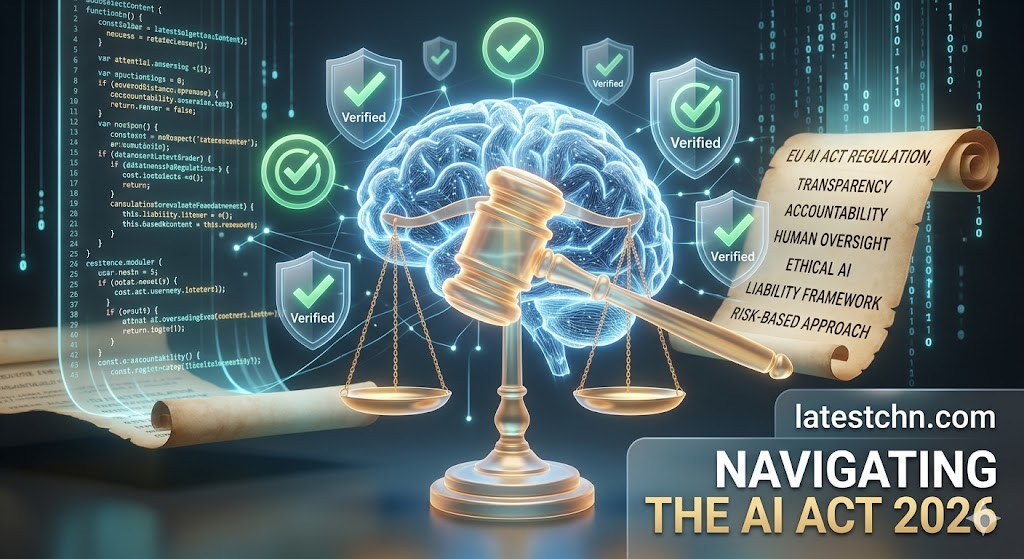
For years, the development of Artificial Intelligence felt like the “Wild West.” Innovation moved at light speed while laws remained stagnant. However, as we move through 2026, the era of unregulated AI has officially ended. From the European Union to the African Union, governments are implementing sweeping AI Regulations that change how algorithms are built, deployed, and monetized.
At latestechn.com, we believe that understanding these laws is just as important as understanding the code itself. Whether you are a developer, a business owner, or a digital creator, these regulations will determine the future of your digital footprint.
1. The Core Pillar: Risk-Based Categorization
The global consensus on AI regulation in 2026 follows a “Risk-Based Approach.” Governments are not banning AI; they are categorizing it based on its potential to cause harm to human rights or safety.
Unacceptable Risk (Banned)
In many jurisdictions, certain AI applications are now strictly prohibited. This includes Social Scoring systems and real-time biometric identification in public spaces for mass surveillance.
High-Risk AI
This category includes AI used in critical infrastructure, education, healthcare, and law enforcement. If you are developing an AI tool that filters job applications or determines credit scores, you are now subject to strict logging, transparency, and human oversight requirements.
2. Transparency and the “Watermarking” Mandate
One of the most discussed topics in 2026 is Generative AI Transparency. With the rise of deepfakes and AI-generated misinformation, regulators now require that any content be it text, image, or audio generated by AI must be clearly labeled.
Digital Watermarking (SynthID and Beyond)
Leading tech companies are now legally mandated to embed cryptographic watermarks into AI outputs. This allows search engines like Google and social platforms like TikTok to automatically tag content as “AI-Generated,” ensuring users aren’t misled. For creators on latestechn.com, this means being honest about your tools is no longer a choice it’s a legal requirement.
3. Copyright and the Fair Use Battle
Who owns the output of an AI? This is the billion-dollar question of 2026.
- Training Data Rights: New laws require AI companies to be transparent about the datasets they use for training. If an AI was trained on copyrighted articles or art without permission, the original creators are now entitled to royalties.
- Output Ownership: In many regions, AI-generated work cannot be copyrighted unless there is “Significant Human Input.” This reinforces the importance of the “Human-in-the-loop” strategy we advocate for.
4. The EU AI Act vs. The Rest of the World
The European Union’s AI Act has become the “Gold Standard” for global regulation, much like GDPR was for data privacy.
- The Brussels Effect: Because the EU market is so large, most global tech companies are adopting EU standards worldwide to simplify their operations.
- African AI Frameworks: We are seeing a surge in localized frameworks across Africa, focusing on preventing “Data Colonialism” and ensuring that AI models are culturally relevant and linguistically diverse.
5. Liability: Who is Responsible When AI Fails?
In 2026, the “Black Box” excuse where developers claim they don’t know why the AI made a certain decision is no longer legally valid.
- Strict Liability: If an autonomous vehicle or a medical AI makes a fatal error, the manufacturer and the developers are held liable.
- The Right to Explanation: Citizens now have a legal right to ask why an AI made a specific decision about them (e.g., why a loan was denied), and the company must provide a human-readable explanation.
6. Impact on Small Businesses and Freelancers
Many fear that high regulation will kill small startups. However, 2026 regulations include “Regulatory Sandboxes” protected environments where small businesses can test innovative AI tools without facing the full weight of legal penalties, as long as they operate within certain safety boundaries.
7. Conclusion: Compliance as a Competitive Advantage
At latestechn.com, we view regulation not as a hurdle, but as a foundation for trust. In a world full of AI noise, the companies and creators who prioritize ethics, transparency, and legal compliance will be the ones who win long-term user loyalty.
The future of AI is not just about being “smart”; it’s about being “responsible.” Stay tuned as we continue to track the evolving legal landscape of the digital world.
Read The Dawn of Multimodal AI