
Over the last decade, covering emerging technology has provided a front-row seat to the industry’s favorite hype cycles. Quantum computing, for instance, has been declared “the next big thing” for twelve years running without quite crossing the finish line. Similarly, augmented reality has risen, stumbled, and continued to limp along. Witnessing this constant loop naturally builds up a strong immunity to the endless buzzwords. So, when I say that Neuralink’s Blindsight genuinely stopped me in my tracks forced me to sit back, put the coffee down, and think I want you to understand that is not a statement I make lightly.
In September 2024, the U.S. Food and Drug Administration granted Neuralink’s experimental vision-restoration implant its coveted Breakthrough Device Designation. Elon Musk, never one for understatement, announced on X that Blindsight would “enable even those who have lost both eyes and their optic nerve to see” and that it might even work for people born blind. Multiple tech publications ran breathless headlines. Critics fired back almost immediately. The truth, as it almost always is in deep technology, lives somewhere in between those two positions and that is exactly where this article is going to take you.
Why This Matters
An estimated 2.2 billion people globally live with some form of vision impairment, according to the WHO. Of those, at least 43 million are completely blind. Blindsight, if it reaches even a fraction of its stated potential, would represent the single largest medical intervention in the history of human vision care.
What Is Neuralink Blindsight?
Let me start with a clean, honest definition one that strips away the Twitter hyperbole on both sides. Blindsight is an experimental cortical brain implant developed by Neuralink, designed to restore some degree of visual perception to people who are completely blind. Its core innovation: it doesn’t touch the eyes at all.
Traditional approaches to restoring vision work by stimulating the retina
The light-sensitive tissue at the back of your eye. This only helps people whose eyes still function at least partially. Blindsight takes a fundamentally different approach. It connects an external camera (think a small device embedded in glasses or a headband) to a microelectrode array that is surgically implanted directly into the visual cortex the region of the brain at the back of your skull that actually processes visual information.
The optic nerve? Bypassed. The retina? Irrelevant. Even the eyes themselves? Optional. If your visual cortex is intact, Blindsight in theory can speak to it directly in the brain’s own language: electrical pulses.
“Blindsight will enable even those who have lost both eyes and their optic nerve to see. We’re confident that even those born blind could see for the first time.” Elon Musk, X (formerly Twitter), September 2024
It is worth being precise about what “see” means here. Musk himself acknowledged on X that initial resolution would be “low, like Atari graphics” and eventually compared it to playing a first-generation Nintendo game. That is a long way from normal vision. But for someone who has never perceived light, shape, or movement at all? Even Atari is a universe away from total darkness.
How Does Neuralink Blindsight Actually Work?
Step One: Capture the World Through a Camera
The system begins outside the brain entirely. A miniaturized camera small enough to be embedded in a pair of glasses continuously captures the visual field of the user. This is similar in concept to the external cameras used in older cochlear implant systems but optimized for very high frame rates and low-latency signal processing.
Step Two: Encode the Visual Signal Into Neural Language
Here is where the deep engineering lives. The raw camera feed is processed by a compact, wearable processor that converts each frame into a precise map of electrical stimulation patterns. The processor essentially asks: “What pattern of electrode activations, fired in what sequence and at what intensities, would cause the visual cortex to interpret this image as meaningful?” This is an extraordinarily hard computational problem, and it is the part of Blindsight that I think is most underappreciated in popular coverage.
Step Three: Stimulate the Visual Cortex Directly
The implanted microelectrode array embedded in the primary visual cortex at the back of the skull receives wireless signals and fires individual electrodes in precisely timed patterns. Each electrode activation produces what neuroscientists call a phosphene: a subjective perception of a point of light. Fire the right electrodes in the right sequence, and those phosphenes resolve into recognizable shapes, edges, and eventually, meaningful images.
This is not science fiction. Phosphene induction via cortical stimulation has been demonstrated in laboratory settings since the 1960s. What Neuralink is attempting to do is scale, miniaturize, and productize that concept into a device with enough electrodes and enough signal precision to produce genuinely useful visual resolution.
Step Four: The Brain Adapts
This is the part that excites me the most, and it rarely gets sufficient coverage. The human brain is remarkably plastic, especially when introduced to new, consistent sensory input. Early cochlear implant users described hearing as robotic and alien; within months, most reported it as natural speech. Neuralink and neuroscientists broadly believe that cortical Blindsight users will experience something similar the brain progressively “learns” to interpret the electrode-generated phosphenes as coherent visual information. Over time, what begins as blurry, low-resolution grid patterns may resolve into increasingly detailed perception.
Technical Specification
Neuralink’s existing N1 chip (used in the Telepathy motor implant) contains 1,024 electrodes across 64 flexible threads. For reference, a standard retinal prosthesis the kind used in devices like the now-discontinued Argus II had just 60 electrodes. Blindsight is expected to use a visual-cortex-specific variant of this array architecture, though exact specifications have not been publicly released.
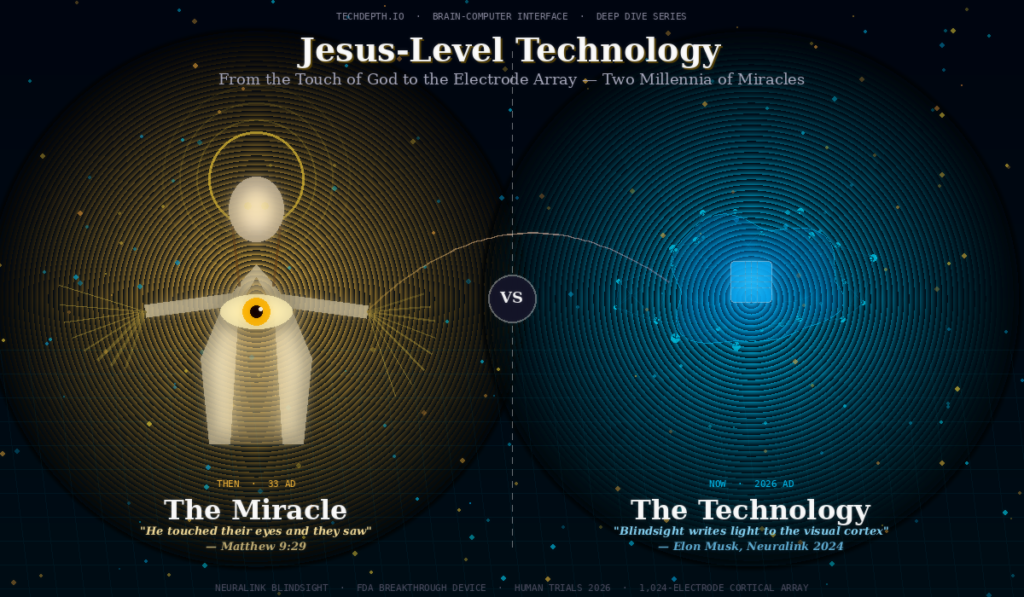
Why Elon Musk Called This “Jesus-Level Technology”
Here is where I need to be analytically careful, because the phrase “Jesus-level technology” has circulated widely in connection with Neuralink but it requires context. Musk did not use that exact phrase in his September 2024 Blindsight announcement. What he and others at Neuralink have repeatedly invoked is the biblical archetype of restoring sight to the blind a miracle framing that Musk himself has leaned into deliberately when discussing Neuralink’s broader vision for the human nervous system.
During a 2022 Neuralink demonstration event, Musk explicitly said the goal of Neuralink was to enable the kind of capabilities that would have seemed miraculous in any previous era of history: restoring vision, allowing the paralyzed to walk, enabling the deaf to hear. The “Jesus-level” framing is not idle marketing it is Musk’s way of anchoring the company’s ambition to a recognizable cultural reference point for genuinely transformative medical restoration.
And here’s the thing: from a purely technical standpoint, the ambition is not indefensible. If a device can allow someone born with no visual experience whatsoever to perceive meaningful shapes and navigate the world with greater independence, that is by any historical standard an extraordinary achievement. The question is not whether the ambition is audacious. It clearly is. The question is whether the engineering can deliver it.
The Old World vs. The New: A Real Paradigm Shift
To understand why Blindsight matters, you need to understand what came before it and why those technologies fell short. I’ve tracked this space for years, and the contrast is genuinely stark.
| Category | Traditional Visual Prosthetics | Neuralink Blindsight |
|---|---|---|
| Stimulation Target | Retina or optic nerve (requires partial eye function) | Visual cortex directly (no functional eye required) |
| Electrode Count | 60–200 electrodes (e.g., Argus II: 60) | 1,000+ electrodes planned |
| Who It Helps | Only those with intact retinal/optic nerve tissue | Anyone with an intact visual cortex including congenitally blind |
| Signal Route | Eye → Retina → Optic Nerve → Brain (must pass through damaged tissue) | Camera → Processor → Cortex (bypasses the damaged pathway) |
| Commercial Status | Multiple companies (Second Sight, Pixium) reached market then failed financially | Pre-clinical / FDA Breakthrough Designation; human trials expected 2026 |
| Long-Term Scalability | Limited by retinal anatomy and optic nerve degradation | Potentially scalable with increasing electrode density |
The most significant shift is the patient population. Retinal prosthetics like the Argus II (which was discontinued in 2019) could only help people who had lost vision due to degenerative retinal diseases while their optic nerve remained functional. That is a narrow subset of the blind population. Blindsight’s cortical approach theoretically extends to anyone including those who lost their eyes to trauma, disease that destroyed the optic nerve, or even people born without functional visual hardware at all.
That is a paradigm shift. A genuine one. I don’t throw that phrase around carelessly.
My Honest Expert Assessment: Hype or Revolution?
This is where I’ll give you the perspective that most tech coverage fails to provide: a grounded, honest assessment that neither cheerleads nor reflexively dismisses.
What I believe is genuinely real and promising
- The cortical stimulation science is solid. This is not speculative physics. Phosphene induction via visual cortex electrodes has been documented in peer-reviewed literature for decades. The fundamental neuroscience is established.
- Neuralink’s miniaturization is a genuine engineering breakthrough. The N1 chip’s 1,024-electrode density in a coin-sized implant is a substantial leap over anything previously commercialized. That engineering achievement is real, regardless of what you think of Musk.
- The FDA Breakthrough designation is meaningful—with caveats. While it is true that hundreds of devices receive this designation annually, accelerate the regulatory path and signals FDA engagement, not approval; it is a fast lane.
- Brain plasticity is a legitimate force multiplier. The cochlear implant analogy is instructive and apt. Early cochlear users reported a distorted, robotic auditory experience that gradually normalized. The brain’s ability to adapt to new, consistent sensory input is well-documented.
- The congenitally blind angle is the most revolutionary claim—and the most uncertain. Musk’s claim that Blindsight could work for people born blind is based on the fact that the visual cortex exists and remains structurally intact even without visual experience. This is true. Whether a brain that has never processed visual input can be successfully taught to do so via electrode stimulation is a genuinely open scientific question one that makes this either the most extraordinary thing ever attempted in neuroscience, or its most spectacular overpromise.
What I think deserves serious skepticism
- The “exceed normal human vision” claim is almost certainly false. Research from the University of Washington, published in 2024, modeled the theoretical limits of cortical implants and concluded that even extremely high-resolution electrode arrays are unlikely to match let alone exceed normal human visual acuity. The cortex does not respond to electrode stimulation the same way it responds to natural neural input. Scaling electrodes does not linearly scale resolution.
- No company has yet commercialized a cortical visual prosthetic. Second Sight developed the Orion cortical implant, reached early human trials, and ultimately failed commercially leaving some patients with implanted hardware and no ongoing support. Pixium Vision similarly struggled. Neuralink’s financial resources are vastly superior, but money alone does not solve the biology.
- Transparency is concerningly low. As of the time of writing, Neuralink has no public Blindsight page on its website. No peer-reviewed data from the monkey trials Musk referenced has been published. For a company making civilization-scale claims, the absence of published data is a legitimate red flag not a disqualifier, but a flag.
- The surgical risk equation is real and underreported. Implanting electrodes into the primary visual cortex is not a minor procedure. It carries risks of infection, scar tissue formation (which degrades electrode performance over time), and potential permanent neurological damage. The long-term durability of any neural implant in living brain tissue remains an unsolved engineering problem.
The Ethics Question Nobody Is Asking Clearly Enough
From a web specialist’s perspective, I spend a lot of time thinking about how information shapes perception and the Blindsight conversation has an ethical dimension that deserves more attention than it’s receiving.
The first concern is informed consent at scale. When a technology is endorsed by one of the world’s most prominent and polarizing entrepreneurs, the signal-to-noise ratio collapses. Desperate families of blind children, adults who have lost their sight to disease, veterans who lost their vision in service these are vulnerable populations who deserve sober, complete information. Musk’s communication style is optimized for virality, not for the careful, qualified messaging that medical contexts demand.
The second concern is the commercialization pressure on brain implant data. Neuralink is a private company with investors and a commercial mandate. The neural data generated by Blindsight users data about what they look at, how their brain processes images, how their visual cortex responds is extraordinarily sensitive. The privacy frameworks for this kind of neurodata are, at present, essentially nonexistent. This is a regulatory gap that I think is genuinely dangerous, and it deserves legislative attention now, before these devices reach mass adoption.
Third: who gets access? If Blindsight works, it will almost certainly be expensive prohibitively so, at least initially. The history of medical technology suggests a painful gap between “this technology exists” and “this technology is accessible to the people who most need it.” A world where Blindsight restores vision only to wealthy patients in wealthy countries is not the world Musk’s “Jesus-level” framing implies.
Expert Verdict
Neuralink Blindsight is not hype and it is not a cure. It is a genuine scientific and engineering frontier project with real conceptual foundations, real technical challenges, and real transformative potential. The cortical bypass approach is a legitimate paradigm shift. The claims about exceeding normal human vision are almost certainly inflated. The claims about helping people who have never seen before are genuinely extraordinary and genuinely uncertain in equal measure. What I am confident in: this technology, in some form, will reach human patients. Whether it delivers on its most ambitious promises depends on biology, engineering, and regulatory integrity not on Twitter posts. The honest answer to “is this Jesus-level?” is it could be. Come back in a decade.
What Happens Next: The Road to Human Trials
According to multiple sources tracking Neuralink’s pipeline, human trials for Blindsight are expected to begin in 2026. The FDA Breakthrough designation significantly accelerates the review timeline and enables Neuralink to collaborate directly with FDA experts throughout the trial process rather than waiting for formal review gates.
The trial design will be critical. Early participants will almost certainly be adults who have lost their vision through injury or disease not people born blind as their visual cortices will have pre-existing “maps” of visual experience that may respond more predictably to electrode stimulation. The congenitally blind application, if pursued, will require far more fundamental research into cortical plasticity.
Meanwhile, Neuralink’s existing implant program the Telepathy motor BCI continues to generate real-world data from human patients. In August and September 2025, Canada’s University Health Network performed the first Neuralink implant surgeries outside the United States, on two patients with cervical spinal cord injuries. This operational expansion matters for Blindsight: it demonstrates that Neuralink is building the surgical and clinical infrastructure to support a multi-indication BCI program, not just a single-product moonshot.
Conclusion: The Audacity Is the Point—and the Problem
Here is what I want to leave you with, as someone who processes technology claims professionally every day: the audacity of Blindsight’s ambition is simultaneously its greatest asset and its greatest liability.
The asset: Elon Musk’s willingness to make claims that established medical device companies would never make has drawn resources, regulatory attention, public awareness, and engineering talent to a problem space cortical visual prosthetics that was languishing in academic papers and underfunded startup failures. The field is moving faster because of Neuralink’s involvement. That is genuinely good for the millions of people who are blind.
The liability: Those same audacious claims set expectations that the technology, in its current state, cannot meet. And when gap between promise and delivery is that large, the reputational damage can set back the broader field scaring off investors, confusing patients, and generating regulatory friction that slows down the legitimate work.
My position, after researching this thoroughly: Neuralink Blindsight is the most serious attempt ever made to solve the right problem cortical vision restoration using the right approach (direct visual cortex stimulation at unprecedented electrode density). The Jesus-level framing is premature. But the technology? The technology deserves every bit of our attention, our scrutiny, and carefully, cautiously our hope.
Watch this space. And when human trial data starts to emerge, I’ll be here to help you read it clearly.
REead
- What is Agentic AI? How Autonomous Agents Are Reshaping Work
- X Finally Fight Hate and Terror Content in the UK
- Honda Goes All-In on Hybrid: Accord & RDX Prototypes Revealed