
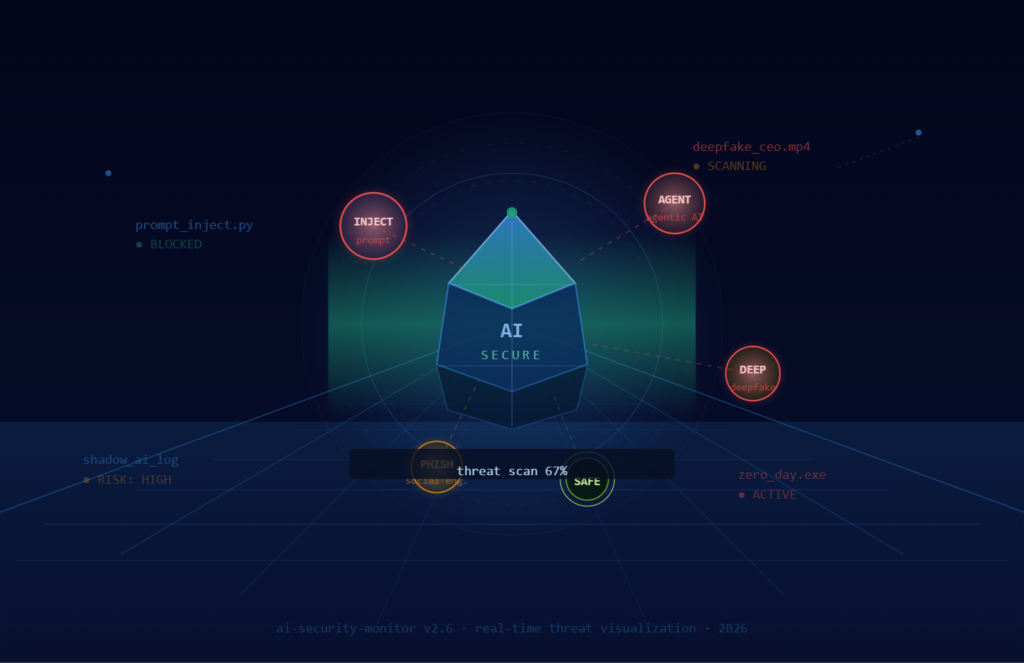
Introduction: The Honest Conversation Nobody Wants to Have. In our today world let we see AI security challenges
There is a sentence in technology that companies spend millions of dollars trying to avoid saying out loud:
“We don’t fully know what we’re doing yet.”
In the world of AI security, that sentence is the most honest thing anyone can say it. Not the consultants, the vendors, even Google.
In May 2026, Google’s own threat intelligence group confirmed it had disrupted a criminal operation. Where hackers used AI to find and weaponize a zero-day vulnerability in another company’s system. The group’s chief analyst, John Hultquist, said something that deserves to be pinned to every security team’s wall: “The reality is that it’s already begun.”
He wasn’t talking about a future threat it was talking about right now.
This article is not another list of AI security trends or a vendor pitch dressed up as advice. It is a real, grounded look at why AI security is hard for everyone including the biggest companies. What that means for you, whether you run a small business, manage a security team, or are simply trying to understand the world you live in.
If you want generic statistics, you can find them anywhere. What you will find here is something more useful: an honest map of where the confusion comes from, why even well-funded organizations keep making the same mistakes, and what actually helps.
The Problem Is Not Ignorance It Is Speed
The first thing to understand is that the AI security problem is not a knowledge problem. It is a speed problem.
Security frameworks, compliance standards, and best practices are all built on one assumption. That the threat landscape changes slowly enough for humans to study it, write policies about it, and train teams to respond to it. AI has broken that assumption completely.
Consider what happened between 2023 and 2024 alone. According to Stanford’s Human Centered AI Index, publicly reported AI security incidents increased by 56.4% in that single year. That is not a gradual trend it’s a category expanding faster than the defenses designed to contain it.
By 2026, IBM’s X-Force Threat Intelligence Index revealed a 44% increase in attacks that started by exploiting public-facing applications largely because AI tools now help attackers find authentication gaps faster than most security teams can patch them. The same report noted that infostealer malware exposed over 300,000 ChatGPT credentials in 2025 alone. Which means AI platforms now carry the same credential risks as any enterprise SaaS tool except the consequences of a compromised AI account go much further than a stolen login. Attackers can manipulate outputs, inject malicious prompts, and silently redirect the system’s behavior.
The problem is not that companies are asleep, but it is that the attack surface is moving faster than any organization can comfortably follow.
What “AI Security” Actually Means (Most Definitions Are Too Narrow)
Before going further, it helps to be precise about what AI security actually covers, because most conversations confuse two very different things.
The first meaning: is using AI as a security tool deploying machine learning models to detect intrusions, flag anomalies, or automate threat response. This is the version most vendors want to sell you, and it is genuinely useful. AI-powered security tools can process volumes of log data no human team could handle.
The second meaning: is securing AI systems themselves protecting the models, the data pipelines, the APIs, and the user interactions from being exploited, manipulated, or turned against you. This is the harder, newer, and far less understood problem.
Most organizations have invested heavily in the first meaning and almost nothing in the second. That gap is where the most interesting threats now live.
Here is why the second problem is so unusual: you cannot firewall a prompt injection the same way you firewall a network port. Traditional security tools are built around known code vulnerabilities. AI security requires thinking about something fundamentally different how a system behaves when it receives unexpected inputs that look completely normal.
A prompt injection attack, for example, does not look like malware. It looks like a user asking a question. But hidden inside that question or inside a document the AI is asked to read there may be instructions telling the AI to ignore its guidelines, leak private data, or take actions the original developers never intended. In February 2025, a researcher demonstrated exactly this with Google Gemini by embedding hidden instructions in a document, they were able to alter Gemini’s stored memory, causing unexpected behavior in later sessions. Google acknowledged the issue. No financial loss was reported but the reputational signal was clear.
The Shadow AI Problem The Threat You Built Yourself
Here is an uncomfortable truth that most articles on AI security avoid: in many organizations, the most significant AI security risk is not a sophisticated nation-state attacker. It is the marketing manager three desks away who started using an AI tool last Tuesday without telling anyone.
This is what the industry calls “shadow AI,” and by 2026 it has become one of the fastest-growing concerns in enterprise security. According to a 2026 threat report, more than three in four organizations 76% now identify shadow AI as a definite or probable problem. That is up from 61% the year before, a fifteen-point jump in a single year.
What makes shadow AI so difficult to manage is that it is not malicious. Nobody is trying to cause harm. An employee discovers that an AI tool helps them write reports faster, so they use it. They paste customer data into it, or a confidential strategy document, or a legal contract because the AI needs context to help well. And suddenly, data that was supposed to stay inside the organization has been processed by a third-party system nobody evaluated for compliance.
The deeper problem is governance. A survey found that 73% of organizations report internal conflict over who actually owns AI security controls. Is it the CISO? The CTO? The individual business unit that deployed the tool? When ownership is unclear, accountability disappears. And when accountability disappears, nobody fixes the problem until something goes wrong.
This is not a technology failure. It is a culture and governance failure, and it is happening inside companies that have every reason to know better.
Why Google’s Situation Is a Mirror, Not an Exception
When the headline says “even Google is navigating AI security in real time,” the temptation is to read that as reassuring. If Google is struggling, the reasoning goes, at least we’re not alone.
But the more useful lesson is different: if Google with its dedicated threat intelligence teams, massive research budget, and decades of security expertise is still discovering new AI-driven attack patterns in real time, then the idea that any organization can achieve a completed, settled AI security posture is simply false.
That is not a criticism. It is a structural reality of a technology that is evolving faster than any prior category in computing history.
Google’s threat intelligence team recently found criminal groups using AI-generated code to identify and exploit a zero-day vulnerability a previously unknown flaw in a third party’s system. The AI-generated code had telltale patterns: overly explanatory comments, invented severity ratings, coding habits associated with large language models. Google’s analysts could identify it because they knew what to look for. Most organizations do not have that kind of analytical depth.
What this tells us is not that AI-assisted attacks are unstoppable. Google did stop this one. What it tells us is that detecting and disrupting AI-enhanced attacks requires specialized knowledge that most security teams have not yet built.
The race is not over. It is ongoing, and it requires ongoing attention not a one-time audit, not a policy document that gets reviewed once a year, and not a checkbox on a compliance form.
The Identity Problem Who Is Actually on the Other End?
One of the most unsettling shifts in AI security is what it has done to the concept of identity. For decades, security systems have been built on the assumption that, while accounts can be compromised, verifying identity is at least theoretically solvable. You can check credentials, use multi-factor authentication, verify a voice on a phone call.
AI has made each of those assumptions significantly harder to trust.
Generative AI is now capable of producing synthetic voice, video, and text that is, in many cases, indistinguishable from the real thing. The security implications are severe. A CFO receives a voice message from what sounds exactly like the CEO, asking for an urgent wire transfer. A government official receives video that appears to show a colleague authorizing a payment. This is not speculative: in late 2024, a municipality was successfully defrauded when criminals used deepfake audio of government officials to approve fake payments.
Looking ahead, security researchers predict that the “CEO doppelgänger” a real-time AI-generated replica of a leader capable of conducting live conversations will become an imminent threat in 2026. The problem is compounded by the rise of machine identities. Enterprises now have AI agents operating inside their systems, taking autonomous actions under legitimate credentials. These agents need access rights. They make decisions. And when those agents are compromised or manipulated, the attacker operates under the full permissions of a trusted system insider.
The question “who is on the other end?” has never been harder to answer, and the answer has never mattered more.
Agentic AI: When the Tool Can Also Be the Threat
There is a category of AI development that has moved from experimental to mainstream faster than almost anyone predicted: agentic AI. These are AI systems that do not just answer questions. They take actions, browse the internet, execute code, access files, interact with other systems, and make sequences of decisions without asking for human approval at each step.
The productivity case for agentic AI is real. An AI agent that can research, summarize, draft, send, and follow up on a project. Security Operations Centers are already deploying agents to triage alerts automatically, cutting response times from hours to seconds.
The security case for concern is equally real. An AI agent that has been compromised through a prompt injection in a document it was asked to read. Or through a manipulated upstream model it depends on does not just leak data. It acts, make API calls, modify files, interact with other agents in a chain, propagating the manipulation downstream before any human notices.
This is what security researchers mean when they say the “blast radius” of an AI compromise has grown. A single manipulated model, operating inside an agentic system with broad access rights, can influence many downstream processes before the damage is visible. And because AI agents are designed to work quietly in the background, the window between compromise and detection can be long.
The conventional response “just limit the AI’s access rights” is correct in principle, but in practice it is harder than it sounds. Every permission you remove from an AI agent reduces its usefulness. The business pressure to give agents more access is constant and security pressure to limit that access has fewer advocates in most organizations.
What Actually Helps: Five Honest Recommendations
Given everything above, what actually moves the needle? Here are five recommendations that hold up under scrutiny not because they solve the problem, but because they address the real dynamics at play.
1. Treat AI tools like you treat third-party vendors because they are.
Every AI system your organization uses processes data. That data may be stored, logged, used for training, or exposed to other customers on the same platform. Before deploying any AI tool, ask the same questions you would ask a vendor with access to your customer data: where is the data stored, who can access it, what happens to it, and what does the contract actually say about liability? This is not bureaucracy for its own sake. It is basic risk management applied to a new category of tool.
2. Assume prompt injection is possible in every AI workflow.
If your organization has AI systems that read external content emails, documents, web pages, customer submissions those systems are potentially vulnerable to prompt injection. The defense is not to eliminate external content, which is often impossible but, it is to design AI workflows that treat external content as untrusted input, and to add human review at decision points where the stakes are high. This is the AI equivalent of input validation it should be a design requirement, not an afterthought.
3. Solve the ownership question before the incident happens.
Who owns AI security in your organization? If that question takes more than thirty seconds to answer, you have a governance gap that will matter during an incident. Define ownership explicitly. Assign it to a named individual or team. Give that person or team actual authority to set and enforce policies. This sounds administrative, but it is one of the most consequential things any organization can do.
4. Build AI security literacy at every level, not just the technical layer.
The deepfake CFO call succeeds not because the technology is unbeatable, but because the employee receiving the call did not know to question it. The shadow AI problem grows not because employees are reckless, but because they were never told what questions to ask before using an AI tool. Security awareness training needs to include AI-specific scenarios: what a prompt injection might look like, how to verify the identity of a request, and when to escalate. This is inexpensive relative to the risks it mitigates.
5. Accept that “done” does not exist, and build for continuous review.
Every organization with a mature security posture knows that security is a practice, not a destination. The same is true of AI security, only more so And The threat landscape is changing month to month. AI capabilities available to both defenders and attackers are evolving faster than any annual review cycle can track. Build a quarterly cadence for reviewing AI deployments, testing for new vulnerability patterns, and updating policies. The goal is not to achieve perfection it is to stay within a reasonable distance of a threat landscape that keeps moving.
A Personal Observation The Confidence Gap
In writing and researching this topic over time, one pattern shows up again and again: the organizations that are most confident about their AI security posture are often the ones with the most reason to be uncertain.
This is not because confident organizations are foolish. It is because confidence in AI security is often a signal that the scope of the problem has been underestimated. If you think you have AI security “handled” through a policy document and an approved vendor list, you likely have not yet encountered a prompt injection attempt, a shadow AI disclosure, or an agentic system behaving unexpectedly under a novel input.
The organizations that tend to be most genuinely secure are the ones that are most genuinely humble about what they do not yet know. They ask uncomfortable questions, run adversarial tests, assign real ownership rather than diffusing it. And they accept that the posture they have today will need to be revisited next quarter.
That humility is not weakness. In the current landscape, it is the most strategically sound position available.
Conclusion: The Race Has Already Begun
John Hultquist’s quote from Google’s threat intelligence team deserves to be repeated: “The reality is that it’s already begun.”
He was talking about AI-assisted attacks. But the same sentence applies to AI security as a discipline. The organizations that will navigate this landscape well are not the ones waiting for the threat to fully materialize before responding. They are the ones treating AI security as an ongoing practice right now asking hard questions, assigning clear ownership, building literacy across their teams, and accepting that the work is never finished.
No company is fully ready for AI security. Not Google, the largest financial institutions, the most security-conscious governments. The question is not whether you will face AI-era security challenges, but it is whether you will face them with a practiced, adaptive posture or with a policy document that no one has read since the year it was written.
The race has begun. How you run it is still up to you.
FAQ